
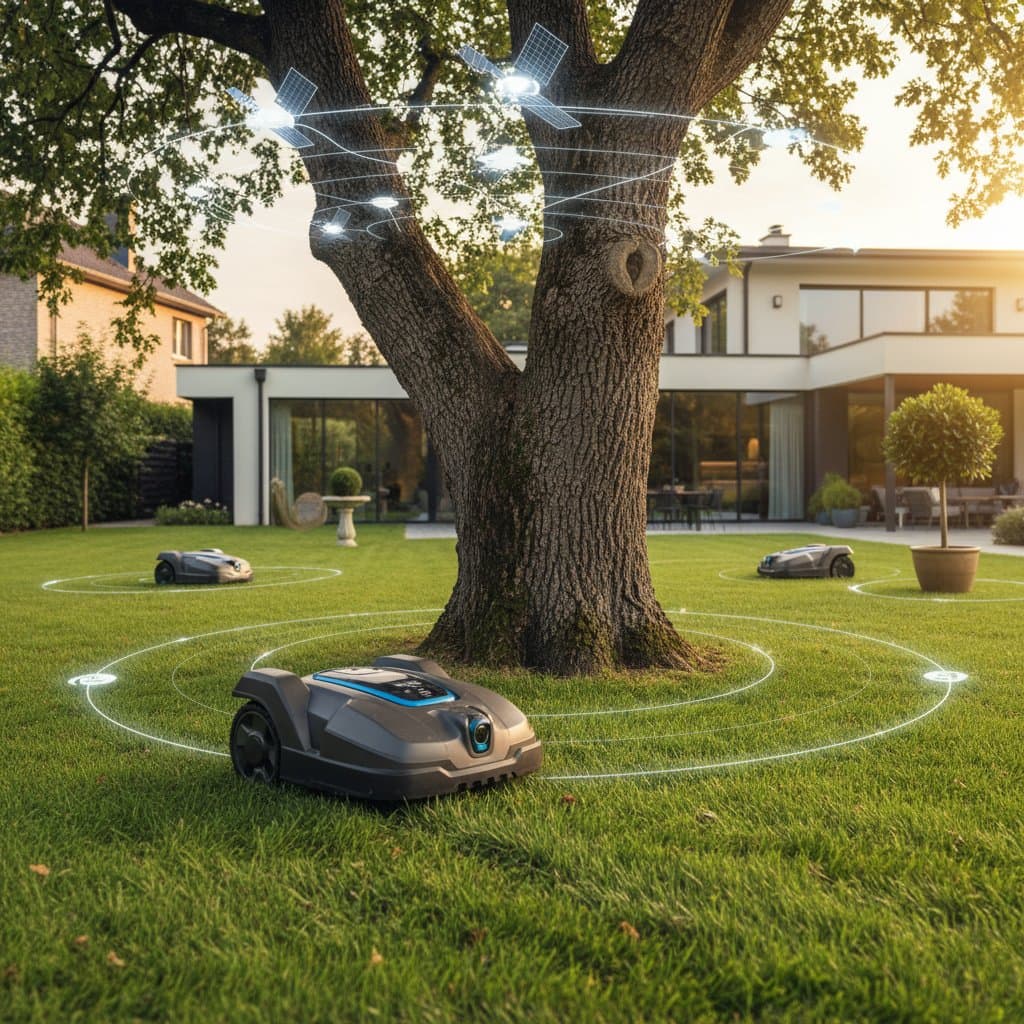
Precision Trimming: Robot Mowers Navigate Trees and Obstacles with Ease
Homeowners often strive for impeccably groomed lawns, but achieving precise cuts around trees and garden borders demands significant effort. The latest robot mowers address this challenge through innovative technology that enables accurate navigation around trees, flower beds, and other features. These developments advance automated landscaping and smart yard systems, allowing users to enjoy a well-maintained outdoor area with minimal intervention.
This resource details the operation of these robot mowers, highlights distinguishing features compared to previous generations, provides selection guidance, and outlines integration into yard maintenance practices.
Robot Mower Pricing Overview
National Average Pricing
Prices for robot mowers vary based on yard size, performance levels, and integrated technologies. Entry-level units for compact spaces align with the cost of conventional push mowers, whereas premium options incorporating intelligent mapping and obstacle avoidance command higher investments. Many users find mid-range models offer an optimal combination of reliability and value.
Pricing by Yard Size or Configuration
- Small yards under 0.25 acres: Basic units suffice and fall at the lower price spectrum.
- Medium yards up to 0.5 acres: Intermediate models with enhanced navigation and extended battery life prove suitable.
- Large properties exceeding 0.5 acres: Sophisticated units featuring GPS, wire-free operation, and multi-zone capabilities become necessary, elevating the overall expense.
Primary Pricing Influences
- Cutting width and battery endurance: Wider blades and robust batteries raise costs yet shorten operational cycles.
- Navigation systems: Integration of GPS, visual sensors, and AI algorithms increases expense while boosting accuracy.
- Build quality and weather resistance: Designs that withstand precipitation, debris, and irregular surfaces endure longer and incur higher initial costs.
- Manufacturer reliability and support: Access to dependable components and efficient service networks supports premium pricing.
- Setup requirements: Certain models necessitate expert boundary wire placement, whereas modern variants employ digital mapping to streamline preparation.
Categories of Robot Mowers
Robot mowers continue to advance, with current iterations primarily differentiated by navigation methods and obstacle management, including trees, beds, and inclines.
Boundary Wire Systems
These represent the standard, budget-friendly option, utilizing a perimeter wire to define the operational zone.
Advantages:
- Established, dependable performance
- Reliable operation within designated limits
- Adaptable to diverse yard configurations
Disadvantages:
- Demands effort for wire placement and upkeep
- Offers limited adaptability to layout modifications
GPS-Guided Systems
These units leverage satellite positioning to chart the property and plot efficient paths.
Advantages:
- Eliminates the need for physical boundaries
- Manages intricate yard geometries effectively
- Optimizes routes to minimize uncovered areas
Disadvantages:
- Exceeds basic models in cost
- Susceptible to signal interference in dense foliage
Vision-Oriented Systems
Equipped with cameras and detectors, these mowers identify obstacles through visual input and achieve refined maneuvering.
Advantages:
- Ideal for properties with numerous trees or barriers
- Automatically adjusts to environmental shifts
- Executes meticulous edging near trunks and perimeters
Disadvantages:
- Involves elevated costs from sophisticated components
- Necessitates frequent lens maintenance
Hybrid AI Systems
The most recent models integrate GPS, visual processing, and machine learning to memorize layouts, distinguish specific trees, and refine operations for delicate areas.
Advantages:
- Superior accuracy and operational efficiency
- Enhances capabilities through ongoing adaptation
- Simplifies initial configuration and ongoing care
**Disadvantages:**n- Reflects high-end market positioning
- Depends on stable internet or cellular access for peak functionality
Self-Installation Versus Professional Services
The complexity of deploying a robot mower depends on the unit and yard design. Tech-savvy individuals with uniform lawns frequently manage the process independently. Wire-dependent models call for careful layout, while GPS and AI variants simplify through app-based adjustments.
Benefits of Self-Installation:
- Avoids service charges
- Builds familiarity with operational elements
- Enables complete personalization
Challenges of Self-Installation:
- Errors may result in inconsistent coverage
- Prolongs effort for expansive or varied terrains
- Demands troubleshooting expertise
Advantages of Professional Services:
- Guarantees precise zone definition
- Tailors performance to site-specific conditions
- Provides instruction on care and upgrades
Individuals with elaborate yards or constrained schedules benefit from expert assistance. Those with modest, regular spaces can proceed solo using detailed instructions and methodical approach.
Robot Mower Installation Guide
Effective preparation yields reliable performance from your robot mower. Adhere to these procedures for seamless deployment.
-
Assess the Lawn Dimensions
Calculate the full area and identify hurdles, gradients, or exclusion zones. This informs model selection and boundary planning. -
Condition the Surface
Clear away loose materials, stones, or branches that might obstruct mechanisms. Level excessive growth for an optimal launch. -
Establish Boundaries
For wire models, secure the line slightly beneath the turf along edges. With digital systems, employ the application to outline virtual perimeters and sectors. -
Position the Base Station
Site the charger on level, sheltered ground near an outlet. Verify unobstructed access for battery recharges. -
Configure the Schedule
Input operational timings, blade elevation, and intervals via the interface or app. Options often include automated sessions during quieter periods. -
Run Initial Tests
Monitor the debut cycle, focusing on tree and edge interactions. Modify parameters for enhanced precision as required. -
Implement Ongoing Care
Inspect and clean components weekly, evaluate mobility, and apply updates to sustain navigational integrity.
Strategies for Optimal Robot Mower Performance
- Maintain sharp blades for uniform shearing and turf vitality.
- Remove blockages routinely, particularly following weather events or usage.
- Account for root systems and ground cover, as dense layers may disrupt detection.
- Apply margin settings to safeguard bark from contact.
- Install software enhancements to access refined routing capabilities.
Common Inquiries
How do robot mowers identify trees?
Contemporary units employ ultrasonic detectors, imaging devices, and computational mapping to detect trunks and circumvent them. They reduce speed and execute cautious passes at the base to prevent harm.
Can robot mowers manage irregular terrain or inclines?
Intermediate and premium models accommodate gentle slopes and varied surfaces. Select units certified for your site's pitch, with treads suited to moist or yielding ground.
Are robot mowers secure around pets and children?
Established brands incorporate halt mechanisms that deactivate upon disturbance. Supervise interactions initially to confirm sensor responsiveness.
Is Wi-Fi essential for robot mowers?
Basic configurations operate on fixed timetables without connectivity. Advanced features rely on networks for modifications, anomaly detection, and app oversight.
What is the ideal running frequency for a robot mower?
Multiple sessions weekly promote even growth and vigor. Incremental cuts per cycle enhance aesthetics and dispense with collection needs.
What upkeep does a robot mower require?
Standard tasks involve blade sanitation, sensor polishing, wheel inspections, and periodic part renewals. Batteries typically last multiple years before substitution.
Achieve a Flawless Lawn with Smart Automation
Integrating a robot mower elevates yard maintenance to a seamless routine, freeing time for enjoyment. Select a model aligned with your property's demands, follow precise setup protocols, and commit to regular adjustments. These intelligent devices not only preserve pristine edges around trees but also foster sustainable, low-effort landscaping for seasons ahead.