
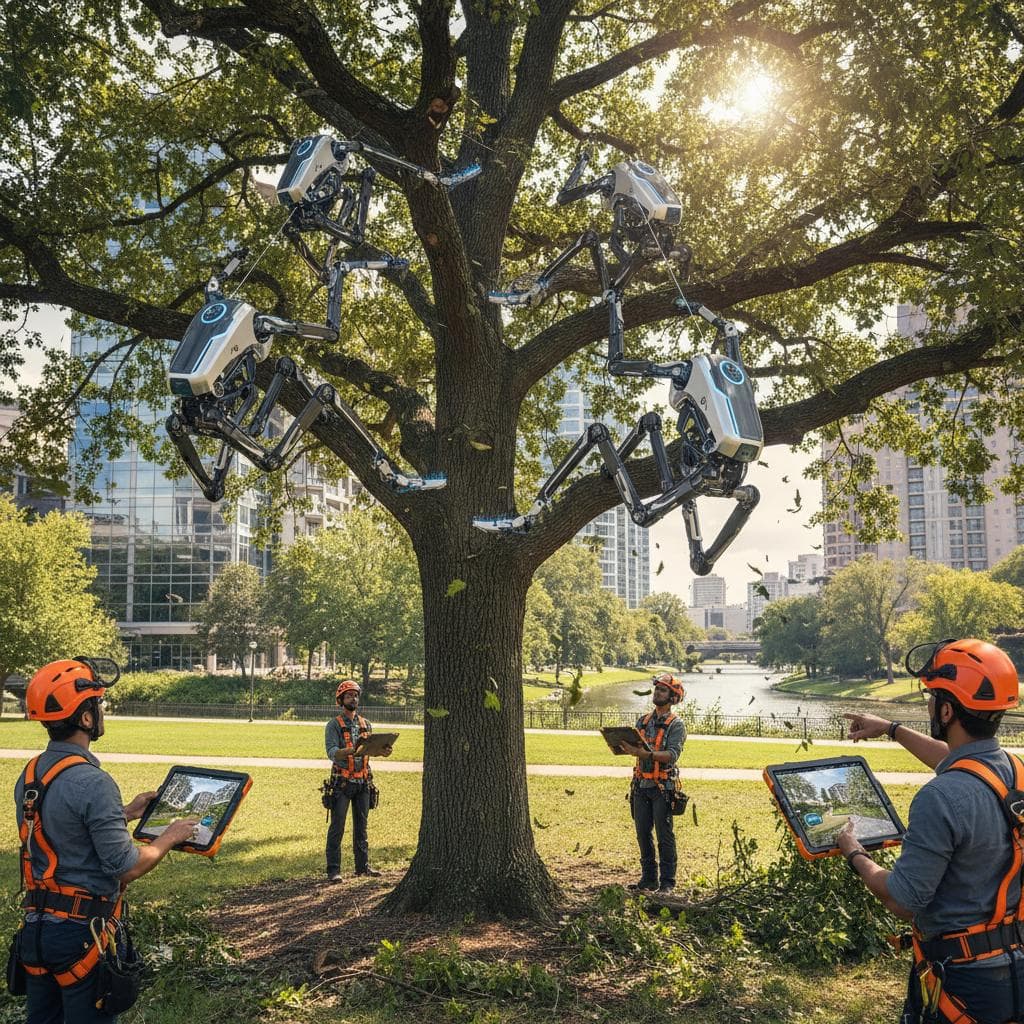
Robot Tree Climbers Prune 3X Faster Than Crews
Robotic tree climbers prune trees up to three times faster than traditional crews. These machines employ sensors, precision cutting tools, and automated movement systems to trim branches with efficiency while reducing risks to human workers. Homeowners and property managers gain a quicker, safer, and frequently more economical option compared to manual methods.
Tree pruning traditionally demands intensive labor and poses significant hazards. Arborists climb to considerable heights, maintain balance, and operate heavy tools amid precarious conditions. Robotic tree climbers integrate robotic precision with arborist expertise to achieve superior outcomes in far less time.
How Robotic Tree Climbers Work
A robotic tree climber functions as an automated system that ascends trees and executes pruning without direct human intervention. It features gripping arms, electric or hydraulic motors, and cameras or sensors to assess the tree structure.
The device secures to the trunk and ascends vertically before traversing branches. Integrated software analyzes the tree to pinpoint branches for removal, then deploys saw blades or shears for accurate cuts. A certified arborist oversees the process remotely, directing operations as needed.
Advanced models incorporate LiDAR or 3D imaging to generate a digital tree representation. This capability enables the system to determine optimal cutting angles and protect undamaged branches. Consequently, pruning proceeds uniformly, preserving tree health and form.
Key Advantages of Robotic Tree Pruning
Robotic systems provide tangible benefits that attract homeowners and tree care professionals alike.
- Speed: These devices finish pruning tasks approximately three times quicker than human teams. They ascend without pauses and execute cuts with exacting precision.
- Safety: Ground-based operation for arborists sharply lowers incidents of falls and tool-related injuries.
- Consistency: Automation yields even pruning that fosters balanced tree development.
- Cost Efficiency: Though equipment acquisition involves upfront investment, accelerated workflows cut labor costs over time.
- Reduced Property Disruption: Precise navigation through the canopy limits harm to surrounding landscapes or buildings.
Such benefits position robotic pruning as a strong option for expansive estates, public green spaces, and business properties emphasizing rapid execution and worker protection.
Comparing Robots and Human Crews
Human teams offer critical insight and flexibility in tree maintenance, yet robots outperform in routine or elevated-risk scenarios. An experienced arborist might require multiple hours to address a substantial oak or maple. In contrast, a robotic climber typically accomplishes the work in one-third the duration.
Human supervision proves indispensable nonetheless. Arborists assess tree vitality, set pruning objectives, and manage intricate shaping that demands seasoned judgment. Robots manage demanding, recurrent duties, allowing professionals to concentrate on strategic oversight and result validation.
This collaborative model yields optimal performance. The machine tackles the exertion, while the arborist safeguards the tree's enduring well-being.
When to Consider Robotic Pruning
Opt for robotic pruning on sites featuring:
- Exceptionally tall or thick trees challenging safe human access
- Extensive tree populations needing regular upkeep
- Confined ground areas unsuitable for ladders or aerial platforms
- Settings prioritizing low noise, minimal interference, or controlled debris
For compact home gardens or decorative specimens, conventional techniques may suffice. As robotic designs grow smaller and less expensive, however, owners of average trees will likely access these innovations soon.
Safety and Environmental Considerations
Elevated tree operations inherently involve dangers like falls, lacerations, or utility conflicts. Robotic climbers substantially mitigate these threats by eliminating worker exposure to heights. They also decrease reliance on large vehicles such as cherry pickers, which risk soil compression and root disturbance.
Environmentally, these systems operate on electricity, emitting no exhaust and generating subdued sound levels versus fuel-driven tools. This profile suits city environments or quiet zones where conventional methods might disturb residents or wildlife.
Costs and Accessibility
Initial costs for robotic tree climbers range from $50,000 to $150,000 per unit, depending on model complexity and capabilities. Service providers often lease equipment or charge per job, with rates starting at $500 for small trees and scaling to $2,000 or more for large-scale projects. Over multiple uses, savings emerge through reduced labor hours and fewer injury claims.
Accessibility improves as manufacturers develop portable versions for smaller operations. Training programs for arborists now include robotic certification, broadening adoption among local firms. For property owners, consulting certified providers ensures compliance with industry standards and maximizes return on investment.
How to Choose a Qualified Robotic Arborist
- Verify operator certifications: Confirm that technicians hold arborist credentials to uphold pruning best practices and tree physiology knowledge.
- Evaluate equipment suitability: Select systems engineered specifically for arboriculture rather than adaptable industrial robots.
- Assess contingency measures: Ensure availability of manual alternatives should robotic functions falter mid-task.
- Review safety protocols: Confirm adherence to guidelines for proximity to utilities or edifices.
- Clarify post-job services: Determine if debris collection and site restoration form part of the package.
Frequently Asked Questions About Robotic Tree Pruning
Can robots prune every tree variety?
Most systems manage prevalent types such as oaks, maples, and pines effectively. Fragile or asymmetrical specimens often necessitate hands-on care.
Does robotic pruning benefit tree health?
Yes, under expert supervision. The devices deliver neat, targeted cuts that lessen trauma and encourage robust recovery.
How much time does a robotic job require?
Pruning one sizable tree generally spans one to two hours, influenced by foliage thickness and elevation.
Do these systems operate in varied weather?
They tolerate mild precipitation or breezes, though intense storms or downpours prompt postponement for caution.
Will robots supplant arborists entirely?
No. Machines execute labor-intensive elements, but professionals handle evaluations, troubleshooting, and nuanced decisions.
Is robotic pruning eco-conscious?
Yes. Battery-operated units avoid pollutants and operate quietly, offering a sustainable edge over combustion engines.
Advancing Tree Maintenance Through Robotics
Integrating robotic climbers transforms arboriculture by blending technology with human skill. Property stewards achieve safer, swifter care that sustains vibrant landscapes. As adoption grows, these tools promise broader access to professional-grade results, benefiting communities and ecosystems alike.