
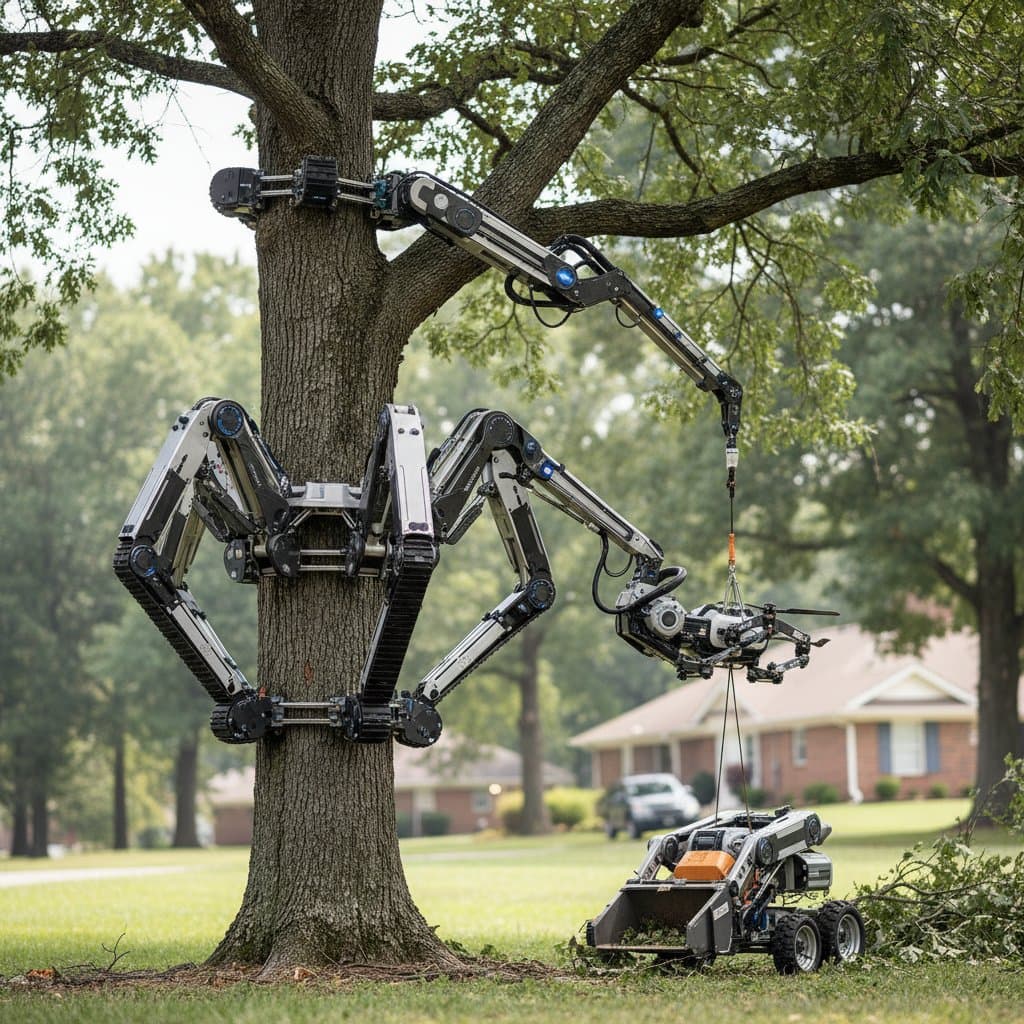
Robotic Tree Climbers Set to Reduce Labor Costs by 50% by 2026
Tree care ranks among the most demanding and perilous occupations in the home services field. Professionals navigate tall heights with chainsaws and manage substantial branches, incurring high risks and expenses related to insurance, gear, and a scarcity of qualified workers. Homeowners and service providers alike grapple with escalating costs. Robotic tree climbers emerge as a transformative solution, automating challenging aspects of tree maintenance. Industry analysts forecast a potential 50 percent reduction in labor expenses as this innovation gains traction.
This resource outlines the mechanics of robotic tree climbers, their pricing structure, influence on service rates, and implications for homeowners amid increasing adoption.
Understanding Robotic Tree Climbers
A robotic tree climber consists of an intelligent, motorized apparatus that secures to a tree trunk and ascends via wheels, treads, or clamping mechanisms. Equipped with integrated tools like saws or shears, it executes branch trimming or severance without requiring human ascent. Operators control certain models remotely, whereas advanced versions employ sensors and artificial intelligence to maneuver through foliage, identify compromised limbs, and execute accurate incisions.
Engineered for enhanced safety, speed, and uniformity, these devices complement rather than supplant arborist knowledge. They target the riskiest elements of the work, allowing experts to focus on strategic oversight and planning.
Pricing for Robotic Tree Trimming Services
Expenses for robotic tree trimming vary based on job scope and equipment deployment. Although the field remains in its growth phase, initial users report efficiencies in time and personnel. Typical charges for robotic-assisted tree trimming span $150 to $1,500, influenced by tree dimensions, foliage thickness, and site access.
| Tree Dimensions and Category | Cost Range |
|---|---|
| Small (under 30 feet) | $150 to $350 |
| Medium (30 to 60 feet) | $350 to $800 |
| Large (60 to 100 feet) | $800 to $1,500 |
| Extra-Large or Hazardous | $1,500 and above |
Relative to conventional techniques, these figures may decrease by 30 to 50 percent with broader implementation, primarily through diminished manual involvement and accelerated workflows.
Key Influences on Robotic Tree Service Expenses
Multiple elements determine the price of robotic trimming or removal. Homeowners benefit from grasping these to anticipate savings and prepare for service selections.
Tree Dimensions
Greater height demands extended ascent and more extensive pruning. Robotic platforms manage scaling effectively, yet exceptionally tall or robust specimens often necessitate human supervision, elevating overall charges.
Tree Health Status
Vigorous trees facilitate smoother robotic navigation. Infested or deteriorated ones present unstable surfaces or fragile timber, potentially restricting grip and requiring supplemental manual intervention or custom fixtures.
Tree Variety
Differences in bark roughness and limb configurations among species like oak, maple, or pine impact climbing and severing efficacy. Smoother exteriors might demand enhanced traction features, marginally increasing fees.
Site Position and Reachability
Proximity to utilities, barriers, or edifices calls for heightened precautions. Robotics excel in confined areas, but preparatory measures and hazard controls contribute to costs.
Seasonal Timing
Peak periods for tree work drive up premiums. Widespread robotic integration enables firms to address surges more adeptly, fostering price consistency across seasons.
Service Urgency
Post-storm clearances demand coordinated human efforts and verifications. While robots aid in perilous settings, expedited requests typically incur surcharges.
Step-by-Step Robotic Tree Service Workflow
Robotic tree services integrate technology with expert guidance in a methodical sequence.
-
Evaluation and Estimation
An accredited arborist inspects the tree for health, scale, and placement. They assess robotic suitability and furnish a detailed quote. -
Preparation of the Site
Crews remove surrounding impediments. Technicians adjust the robot and controls to match the tree's characteristics. -
Ascent and Alignment
The device affixes to the base and advances upward. Visual and sensory inputs guide it to target branches. -
Execution of Cuts and Shaping
Under remote supervision, the robot deploys blades for incisions. Precision features safeguard viable growth. -
Debris Management and Conclusion
Segments descend securely or process on location. Operators retrieve the unit, with teams completing site restoration.
This methodology curtails exposure to heights and accelerates project timelines, often permitting several trees per session.
Evaluating DIY Options Against Professional Robotic Services
Some homeowners consider if robotics democratize tree maintenance for personal use. In practice, comprehensive climbers stay with certified operators, though basic variants may suit minor tasks.
Suitable DIY Scenarios
- Gentle shaping of compact decorative trees or hedges.
- Clearing accessible lower limbs from ground level.
- Routine landscape tidying with portable powered cutters.
Reasons to Engage Experts
- Any tree exceeding 20 feet in height.
- Specimens adjacent to electrical lines, buildings, or pathways.
- Compromised or leaning trees posing stability concerns.
- Extensive shaping, canopy thinning, or complete extractions.
- Situations prioritizing compliance, coverage, and accuracy.
Specialists merge judgment with mechanical aid to uphold codes and best practices.
Selecting a Robotic-Equipped Tree Service Provider
With robotics proliferating, seek firms versed in validated systems and staff proficiency. Follow these steps for optimal choices.
-
Verify Qualifications and Protections
Ensure arborist certifications and comprehensive liability plus workers' coverage. -
Probe Tools and Approaches
Request details on robotic, aerial, or automated integrations and their benefits for security and productivity. -
Solicit Comparative Bids
Obtain itemized proposals from no fewer than three sources, covering techniques, post-work care, and waste handling. -
Examine Testimonials and Ratings
Prioritize feedback highlighting reliability, timeliness, and risk mitigation. -
Secure Written Agreements
Document project parameters, pricing, and obligations prior to commencement. -
Address Ongoing Care and Authorizations
Reputable providers manage regulatory filings for substantial operations.
Common Queries on Robotic Tree Care
What is the expense for extracting a 50-foot pine with robotic support?
Such a tree aligns with medium to large classifications. Assisted removal ranges from $500 to $1,200, varying by locale and intricacies. Savings arise from streamlined labor compared to manual processes.
Does robotic trimming cost less than removal?
Pruning invariably proves more economical than extraction. Robotic methods render trimming 40 to 60 percent below removal costs, particularly for targeted branch work.
Optimal season for robotic pruning?
Dormancy or initial sprouting phases suit trimming best. Robotics function across weather, yet off-season bookings yield preferable pricing and slots.
Coverage under homeowner policies for robotic extractions?
Policies often reimburse hazardous or obstructive tree clearance. Terms hinge on incident origins; robotic use accelerates response without altering eligibility.
Safety profile of robotic climbers?
Affirmative, with embedded detectors and redundancies. They diminish human exposure to dangers, curtailing injury and collateral risks.
Potential displacement of arborists by robots?
Negative; these tools augment rather than supplant experts. Professionals remain essential for diagnostics, choices, and sustainability.
Speed of robotic service completion?
Frequently halving manual durations for individual trees. Scale, complexity, and clearance affect full timelines.
Integrating Robotics for Enhanced Tree Management
Tree care advances through automation, accuracy, and risk reduction. Robotic climbers transition from prototypes to operational assets in select regions. Declining prices and refinements will propel adoption, alleviating workforce gaps.
Homeowners gain from prompt, secure, and budget-friendly upkeep. Services evolve to single-day completions, preserving landscapes with minimal disruption and bolstering asset worth.
Opt for providers leveraging automation to optimize outcomes. Pairing expertise with machinery yields superior tree vitality, personal security, and fiscal efficiency.