
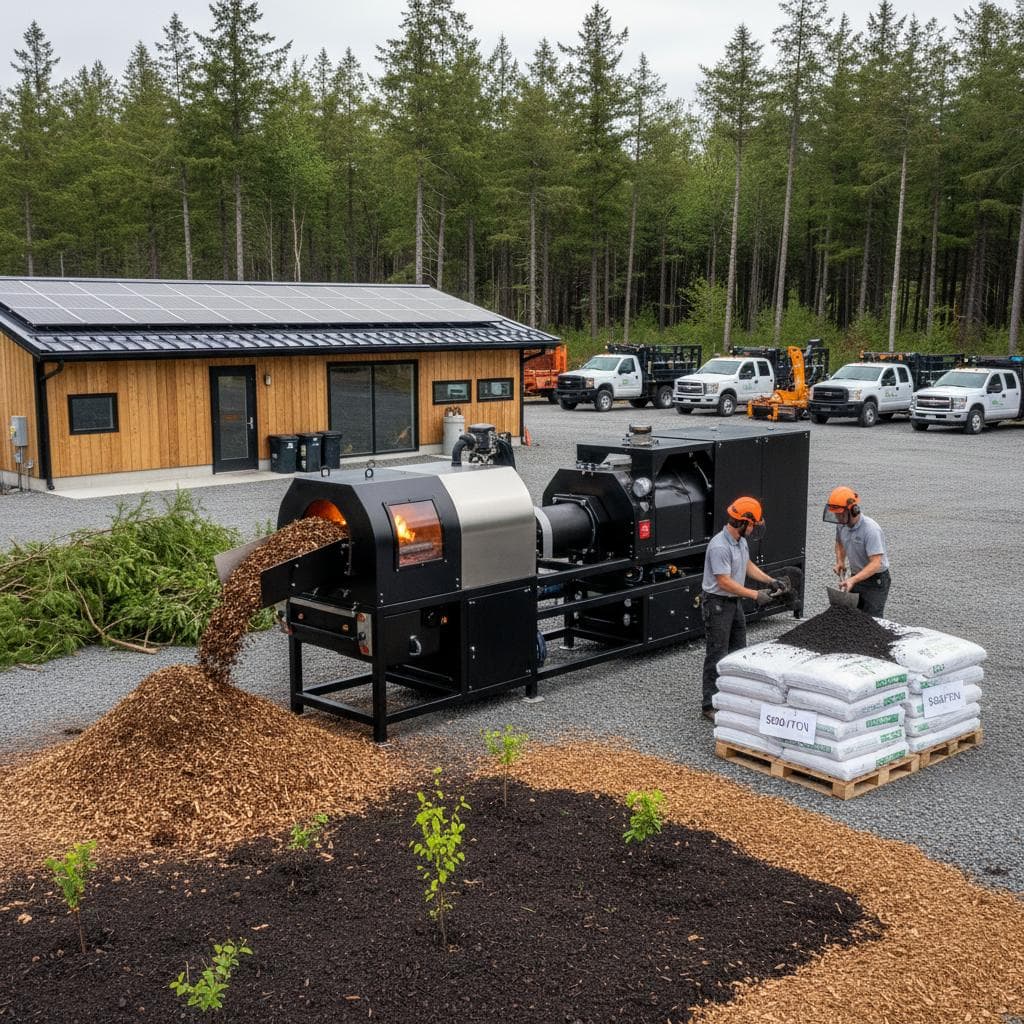
From Tree Waste to $800 per Ton: Unlocking Biochar Profits for Arborists
The conversion of tree waste into biochar evolves from a sustainable practice into a viable commercial venture. Arborists, who previously incurred expenses for transporting and disposing of wood chips and green waste, now possess the means to produce a premium product valued at hundreds of dollars per ton. This development enables tree care experts to integrate environmental responsibility with financial gains.
Assessing Costs and Profit Margins in Biochar Production
Current Market Prices and Production Expenses
Biochar, a carbon-rich material produced from organic matter in a low-oxygen environment, fetches prices nearing $800 per ton for premium varieties. Production expenses depend on factors such as equipment selection, labor requirements, and feedstock quality, yet optimized setups yield biochar at a cost far below market rates. Such economics render the process attractive for operations of varying sizes.
Expenses Relative to Operation Size
For smaller arborists employing mobile kilns or compact reactors, manufacturing costs represent less than one-third of the resale value. Larger facilities that adopt continuous pyrolysis units realize further reductions in per-unit expenses through increased volume and automated processes. Greater availability of tree waste accelerates equipment return on investment.
Primary Influences on Production Costs
- Feedstock characteristics and moisture levels: Dry chips from hardwoods yield superior, more valuable biochar compared to fresh or heterogeneous waste.
- Equipment scale and performance: Portable kilns offer affordable entry points but demand more manual effort; expansive reactors involve substantial upfront costs yet deliver reliable results.
- Labor and operator expertise: Trained personnel optimize carbonization processes and minimize material waste.
- Energy consumption: Certain systems harness syngas from the process itself, thereby lowering reliance on external fuel sources.
- Packaging and logistics: Options for bagging retail quantities or arranging bulk shipments directly affect net profitability.
Overview of Biochar Production Technologies
Mobile Cone Kilns
These durable units, constructed from metal or refractory concrete, facilitate on-site processing. Operators load tree waste in controlled layers for pyrolysis, generating biochar at the point of waste accumulation.
Advantages
- Minimal startup investment
- Straightforward operation
- Suited to fieldwork or limited-scale projects
Disadvantages
- High labor demands
- Inconsistent product uniformity
- Restricted output capacity
Retort Kilns
Retort designs apply indirect heating to biomass, enhancing overall efficiency and output consistency. The systems capture and recycle volatile gases to sustain the pyrolysis process.
Advantages
- Elevated carbon retention rates
- Reduced emission profiles
- Enhanced quality assurance
Disadvantages
- Elevated initial expenses
- Demands technical proficiency
Automated Continuous Pyrolysis Units
Advanced reactors automate feedstock introduction and temperature regulation, enabling high-volume biochar generation with limited oversight.
Advantages
- Rapid throughput
- Uniform product standards
- Adaptable to enterprise-level demands
Disadvantages
- Significant capital outlay
- Necessitates fixed installation and routine upkeep
Choosing Between Custom Builds and Professional Installations
Hands-on arborists may construct or modify basic biochar setups using accessible blueprints and regional resources. Such custom approaches prove cost-effective and permit testing of various feedstocks and pyrolysis conditions. Consistency in output and adherence to safety protocols present the primary hurdles.
Opting for expert fabrication or commercial systems guarantees durability and regulatory compliance. These installations include guarantees, ongoing assistance, and performance validations. For high-volume processing or market sales, professional solutions typically offer superior long-term value.
Step-by-Step Guide to Biochar Production from Tree Waste
-
Collect and Condition Feedstock
Gather untreated wood chips, limbs, or sawdust free from contaminants like paint or chemicals. Reduce moisture through air-drying to optimize the pyrolysis reaction. -
Determine Appropriate Equipment
Select a kiln, retort, or reactor aligned with production targets and budget constraints. -
Establish Secure Processing Zone
Designate a flat, unobstructed area distant from buildings, with adequate airflow and fire suppression tools in place. -
Initiate Pyrolysis Process
Load the prepared material into the unit and apply heat progressively in an oxygen-restricted setting. Monitor temperatures to ensure uniform conversion. -
Terminate and Cool the Product
Upon completion, isolate the biochar from air or apply water quenching to halt further reaction. Permit full cooling prior to any manipulation. -
Process and Prepare for Distribution
Fragment oversized pieces, sift out impurities, and package the biochar for commercial or agricultural use.
Strategies for Effective Biochar Operations
Maintain uniform feedstock particle sizes to promote balanced pyrolysis. Document yields and variables to refine techniques over time. Preserve biochar in moisture-free storage to safeguard its properties. Validate efficacy through small-scale soil trials before broader distribution. Target nearby markets among landscapers, horticulturists, and agriculturalists to minimize transport overheads.
Common Questions on Biochar from Tree Waste
Which Woods Suit Biochar Production Best?
Hardwoods like oak, maple, and hickory generate robust biochar with elevated carbon density. Softwoods serve adequately but often result in less compact material containing higher ash levels.
Is Direct Use of Wood Chips Feasible?
Chipped wood functions well as feedstock once dried. Uniform sizing supports steady heating and avoids partial carbonization.
Does Biochar Production Benefit the Environment?
Proper implementation sequesters carbon, diverts waste from landfills, and enhances soil fertility. Low-emission technologies further reduce ecological impacts.
Are Permits Required for Production and Sales?
Local rules vary; modest operations typically qualify under farming or waste management exemptions, whereas industrial scales may need emission approvals.
How Durable Is Biochar in Soil Applications?
Biochar persists in soils for centuries to millennia, depending on composition and environmental conditions, providing long-term carbon storage and nutrient retention.
Launching Your Biochar Venture
Arborists stand to gain by redirecting tree waste toward biochar production, slashing disposal burdens while cultivating fresh revenue streams. With market values climbing to $800 per ton, targeted setups deliver tangible financial benefits. Focus on reliable equipment, quality assurance, and regional partnerships to establish a thriving, eco-conscious enterprise.