
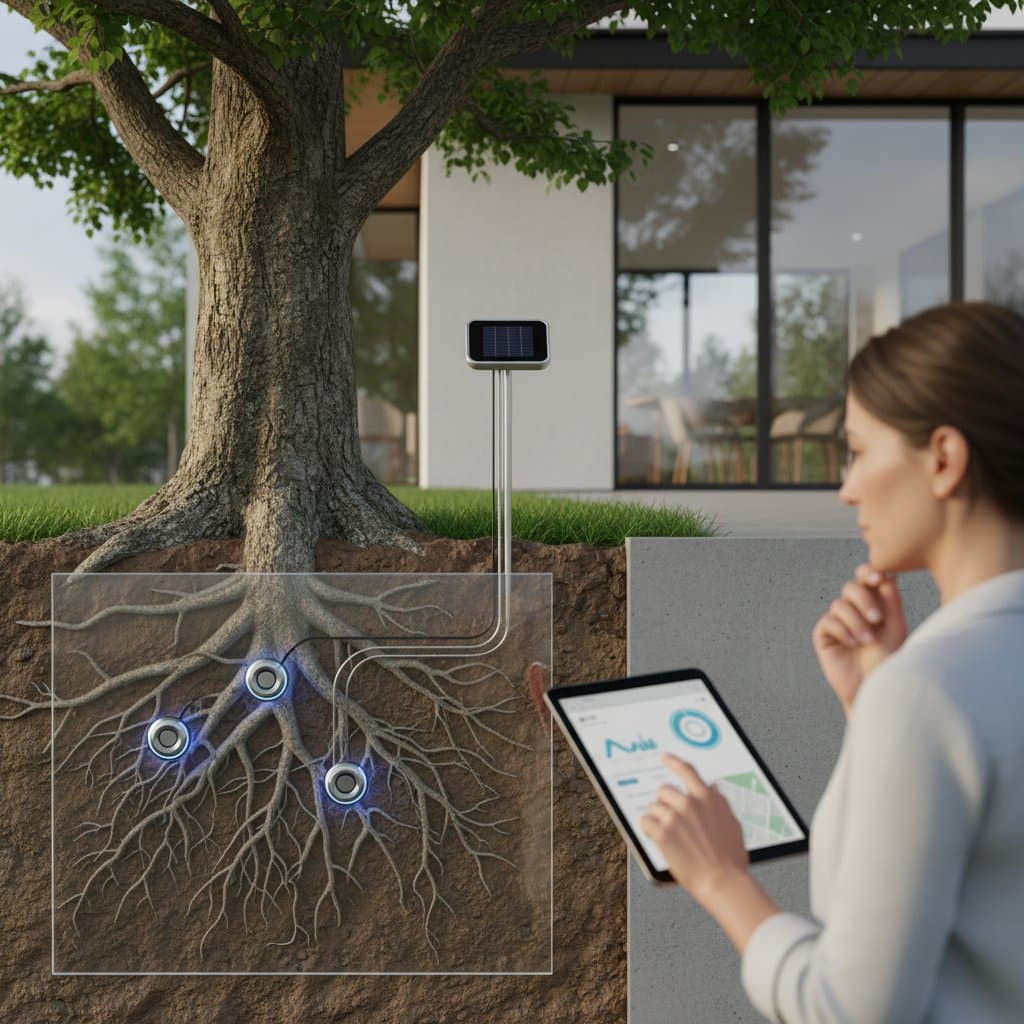
Tree Sensors Shield Foundations from Root Damage
Protecting a home's foundation from tree root damage presents a persistent challenge for homeowners who cherish their trees and property integrity. Mature trees extend roots outward to seek water and nutrients, occasionally encroaching on foundation walls, slabs, and underground utilities. Contemporary tree sensor technology provides a proactive method to track root movement and soil conditions, averting significant damage.
This guide details the operation of tree sensors, associated costs, available types, and their role in safeguarding trees and foundations. It addresses installation options for homeowners versus professionals, along with essential maintenance and monitoring practices for sustained protection.
Tree Sensor Cost
National Average Cost
Pricing for tree sensor systems varies based on sensitivity, connectivity, and installation demands. A single tree root monitoring sensor typically ranges from $150 to $400. For a standard residential yard, systems with multiple sensors result in total expenses akin to a modest landscape enhancement project, often between $500 and $2,000.
Cost by Project Size or Type
-
Single Tree Monitoring: Basic configurations for one substantial tree adjacent to a foundation incorporate two to four sensors, covering a detection radius sufficient to identify root expansion toward the structure, at $300 to $800.
-
Full Property Monitoring: Properties featuring several mature trees benefit from networked systems spanning multiple zones, complete with wireless hubs and data logging capabilities for ongoing surveillance, costing $1,200 to $3,500.
-
Professional Installation: Advanced sensors necessitating trenching or deep soil insertion elevate expenses through specialized equipment and labor, adding $500 to $1,500 to the base system price.
Key Cost Factors
Multiple elements shape the final price:
-
Sensor Type: Wired variants offer lower initial costs yet demand greater installation effort. Wireless options incur higher upfront fees but simplify ongoing upkeep.
-
Connectivity Features: Integration with mobile applications or smart home ecosystems increases expenses by 20 to 30 percent.
-
Soil and Root Density: Dense clay soils or intricate root networks necessitate additional sensors for precise measurements, potentially raising costs by 15 to 25 percent.
-
Installation Method: Self-directed setups reduce outlays, whereas expert installation guarantees optimal positioning.
-
Maintenance and Calibration: Routine adjustments or battery replacements contribute to annual expenses of $50 to $200.
Types of Tree Sensors
Moisture and Soil Condition Sensors
These devices gauge soil moisture, temperature, and nutrient concentrations. They enable homeowners to assess the impact of irrigation practices on root proliferation.
Pros:
-
Mitigates overwatering, thereby curbing root extension toward foundations
-
Facilitates straightforward installation and upkeep
-
Delivers insights essential for maintaining tree vitality
Cons:
-
Offers restricted detection of physical root displacement
-
Demands frequent calibration to sustain precision
Root Growth and Movement Sensors
These sensors identify underground root expansion and orientation through vibration detection or electrical impedance measurements.
Pros:
-
Monitors root incursion proximate to foundations directly
-
Facilitates early intervention to forestall structural harm
-
Performs effectively with established trees exhibiting vigorous root habits
Cons:
-
Exceeds moisture sensors in expense
-
Relies on exact positioning for dependable outcomes
Wireless Smart Monitoring Systems
These integrated platforms merge soil and root sensors with cloud connectivity. Homeowners obtain notifications via mobile applications upon heightened root activity near at-risk zones.
Pros:
-
Supplies instantaneous surveillance and notifications
-
Harmonizes with intelligent irrigation setups
-
Permits data access from remote locations
Cons:
-
Entails elevated initial investment
-
Depends on consistent internet availability
Hybrid Systems
Hybrid configurations unite diverse sensor varieties for thorough environmental evaluation. They suit properties where prized trees neighbor critical structures.
Pros:
-
Furnishes exhaustive safeguarding and data reliability
-
Identifies fluctuations in moisture alongside tangible root alterations
-
Accommodates expansive residential or commercial applications
Cons:
-
Involves intricate assembly
-
Potentially necessitates expert oversight services
DIY vs. Hiring a Professional
Tree sensor installation may seem uncomplicated, yet efficacy hinges on accurate positioning and calibration.
DIY Approach:
Individuals adept at elementary excavation and cabling can deploy basic moisture sensors. Such systems typically provide step-by-step directives and link through Wi-Fi or Bluetooth. This method trims expenses, although erroneous placement or inadequate calibration yields inconsistent results.
Professional Installation:
Licensed arborists or landscaping technology experts conduct soil evaluations to pinpoint ideal sensor sites. They employ ground-penetrating radar to chart root configurations precisely. Specialists manage cabling or wireless networking and verify compatibility with existing irrigation apparatus.
How to Protect Foundations with Tree Sensors
1. Evaluate Tree and Foundation Distance
Measure the separation between tree trunks and foundation edges. Species planted within 10 to 15 feet of structures present the greatest threats. Prioritize monitoring for trees known for extensive root systems, such as oaks or maples.
2. Choose the Right Sensor System
Align sensor selection with specific requirements. Soil moisture units suffice for routine hydration oversight. Opt for root movement specialists to track direct threats. Hybrid arrays provide the broadest informational scope.
3. Prepare the Site
Remove obstructions and designate sensor positions. Optimal spots lie midway between trunks and foundation perimeters. For wired installations, outline trench routes to circumvent harm to irrigation lines or utilities.
4. Install the Sensors
Adhere to producer guidelines regarding burial depth and intervals. Position devices at depths capturing active root zones, typically 8 to 12 inches, while allowing maintenance access. Wireless variants require verification of signal potency to the central hub.
5. Calibrate and Connect
Post-installation, adjust sensors via accompanying applications or interfaces. Enter details on soil composition and tree varieties for refined interpretations. Link the apparatus to personal devices or control panels for oversight.
6. Monitor and Adjust
Examine readings on a weekly basis. Elevated root activity near foundations signals the need to modify irrigation or engage an arborist for selective pruning. Regular calibration upholds precision over time.
Tips for Accurate Monitoring and Long-Term Protection
-
Inspect Sensors Regularly: Examine for wear, disconnections, or soil disturbances quarterly.
-
Adjust Watering Habits: Limit irrigation adjacent to foundations to deter root migration toward damp areas.
-
Combine with Root Barriers: Employ physical shields alongside sensors to enhance defense.
-
Track Seasonal Variations: Root dynamics shift with climate; intensify checks during growth seasons.
-
Consult Professionals Annually: Arborists can analyze patterns and tree conditions for equitable management.
Frequently Asked Questions
How do tree sensors prevent foundation damage?
Tree sensors identify variations in soil moisture and root progression adjacent to foundation barriers. Prompt awareness empowers adjustments in watering or barrier deployment prior to root-induced fissures or displacements.
Are tree sensors safe for the trees themselves?
Affirmative. Sensors reside in the soil without impeding roots. They gather information non-invasively, eschewing incisions or perforations into vital tissues.
Can tree sensors be used with existing irrigation systems?
Contemporary systems integrate fluidly with automated irrigation controls. Declining soil moisture triggers schedule modifications, averting undue root stimulation.
How deep should tree sensors be installed?
Installation depth varies by tree variety and terrain. Placement between 6 and 18 inches generally targets root activity layers, sidestepping superficial moisture influences.
Do tree sensors require ongoing maintenance?
Indeed. Scheduled calibrations, battery swaps, and firmware enhancements preserve reliability. Biannual reviews maintain system efficacy.
Can these systems detect damage already done to a foundation?
Tree sensors observe current activities and environments but lack capacity to assess prior structural impairments. Visible fissures or subsidence warrant evaluation by engineers or foundation authorities.
Implementing Effective Tree Protection
Homeowners intent on fortifying foundations commence with risk assessments around prominent trees, selection of appropriate sensor arrays, and determination of installation expertise. Collaboration with skilled arborists or technologists secures precise deployment and data utilization, fostering enduring harmony between landscapes and residences.