
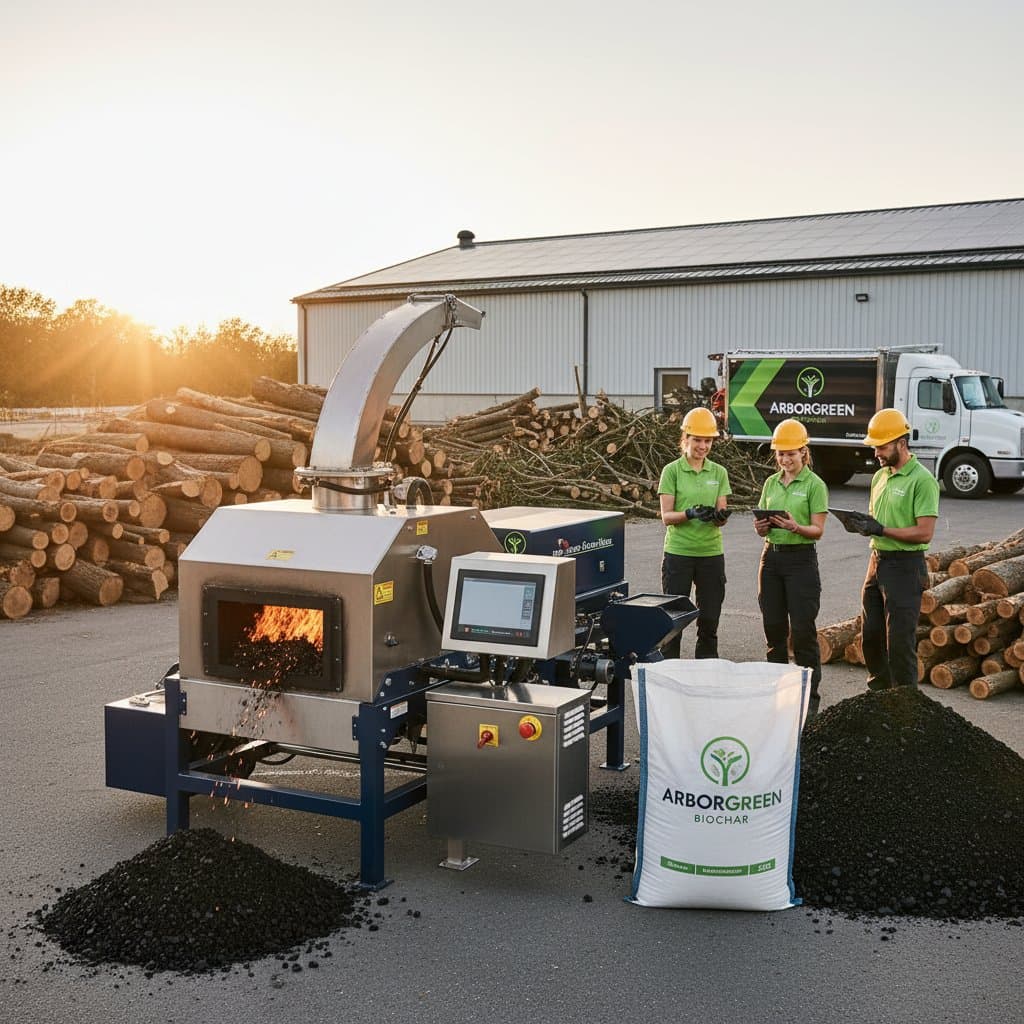
Arborists Transform Tree Waste into Biochar Revenue in 2026
Tree care experts find that wood chips, branches, and logs, previously subject to disposal fees, now serve as sources of income. The conversion of tree waste into biochar evolves from an environmental initiative into a viable commercial strategy. Arborists and tree service firms benefit from this approach through ecological improvements and substantial financial gains.
This resource details the biochar conversion process, examines associated costs and advantages, and outlines integration methods for arborists to achieve sustained expansion.
Biochar Production Costs
National Averages
Biochar production costs depend on equipment scale, feedstock variety, and method employed. Small-scale setups for pruning debris or wood chips demand initial investments ranging from $5,000 to $15,000. Larger mobile or stationary systems incur higher upfront expenses, often $50,000 or more, yet yield increased volume and operational efficiency.
Ongoing costs encompass fuel, labor, maintenance, and feedstock transport. After setup, these expenses prove modest, as tree waste arises directly from routine arborist activities.
Costs by Project Scale or Type
- Small-scale or pilot operations: Suited for arborists handling limited waste. These employ kilns or retorts processing 1 to 5 cubic yards per batch, with costs under $10,000.
- Commercial or collaborative facilities: Tailored for regional efforts or multi-firm alliances. Continuous processors handle tons daily, justifying investments of $100,000 plus for elevated per-ton returns.
- Mobile units: Trailer- or truck-mounted, these enable on-site processing, eliminating haulage costs and boosting workflow.
Primary Cost Influences
- Equipment model and capacity
- Fuel type and energy optimization
- Labor needs and staff training
- Site location and regulatory compliance
- Biochar storage and packaging
- Distribution and sales logistics
Biochar Production System Varieties
Flame-Cap Kilns
Flame-cap kilns consist of open metal vessels that pyrolyze wood under restricted oxygen. These units offer affordability and simplicity for batch processing.
Advantages:
- Minimal initial expense, often below $2,000
- Easy transport and operation
- Yields superior biochar for agricultural applications
Disadvantages:
- Constrained throughput
- Demands hands-on oversight
- Potential smoke output without proper control
Retort Kilns
Retort designs heat wood in enclosed chambers, capturing byproducts for efficient, low-emission operation.
Advantages:
- Uniform biochar characteristics
- Lower pollutant release
- Byproduct heat recovery for auxiliary purposes
Disadvantages:
- Elevated purchase price, starting at $10,000
- Extended cycle times
- Necessitates skilled observation
Continuous Pyrolysis Systems
Automated pyrolysis units process feedstock steadily, generating substantial biochar volumes with reduced manual input.
Advantages:
- Maximal productivity and energy use
- Appropriate for enterprise-level use
- Decreased ongoing labor expenses
Disadvantages:
- High initial outlay, exceeding $100,000
- Intricate installation and upkeep
- Unsuitable for modest arborist operations
On-Site Production Versus Professional Services
Many arborists pursue self-managed biochar creation, leveraging existing debris volumes. Basic tools and safety protocols enable on-site batches via straightforward kilns, facilitating trials and direct application in nearby landscapes.
Professional installations provide reliability. Specialized providers engineer systems for steady output, emission control, and energy savings. They assist with permitting and adherence to ecological norms.
Beginners benefit from modest starts combined with expert collaboration. This path clarifies procedures and demand before committing to proprietary gear.
Steps to Convert Tree Waste into Biochar
1. Gather and Prepare Feedstock
Collect branches, logs, or chips from trims, removals, or cleanup efforts. Exclude painted, chemically treated, or contaminated wood to prevent toxic releases during heating.
2. Reduce Moisture Content
Dried material enhances pyrolysis efficiency and biochar quality. Arrange wood in ventilated, sheltered spaces or expose to sunlight until moisture falls below 20 percent.
3. Charge the Processing Unit
Load prepared feedstock into the kiln or reactor, ensuring even distribution for uniform heating. In flame-cap models, ignite a surface fire to propagate downward.
4. Regulate Pyrolysis
Sustain optimal temperatures between 400 and 700 degrees Celsius with minimal oxygen. Monitor for red-hot glow and ash formation, then extinguish with water or seal to halt burning.
5. Cool and Process
Allow full cooling before fragmenting the char. Grind or sieve to achieve consistent particle size, ideal for soil integration or bagging.
6. Store, Apply, or Distribute
Keep biochar in sealed, dry storage. Blend with compost for enhanced efficacy, or supply to landscapers, growers, and amendment distributors.
Strategies for Effective Biochar Operations
- Initiate with pilot projects to master techniques prior to expansion.
- Assess feedstock dryness to optimize yields and minimize fuel use.
- Source only uncontaminated wood to maintain product purity.
- Activate biochar by mixing with nutrients or compost before deployment.
- Document expenses and outputs to assess viability and adjust methods.
Common Inquiries
What Materials from Tree Waste Form Biochar?
Biochar results from heating wood or plant matter in low-oxygen conditions. Branches, chips, and trunks yield resilient, absorbent char effective for soil enhancement.
In What Ways Does Biochar Enhance Soil?
Biochar refines soil texture, boosts moisture holding, and fosters microbial activity. It sequesters carbon durably, mitigating atmospheric emissions.
Do Arborists Achieve Profitable Biochar Sales?
Affirmative. Post-equipment amortization, biochar commands premium prices as a soil improver. Rising needs in farming, horticulture, and remediation support strong markets.
Does Biochar Production Demand Specialized Training?
Fundamental safety and operational understanding suffice initially. Workshops, digital courses, and supplier guides equip arborists for secure, productive runs.
What Regulations Govern Biochar Production and Sales?
Requirements differ locally. Permits may apply to combustion or conversion activities. Consult regional environmental and air authorities for compliance.
How Might Arborists Promote Their Biochar?
Target sales to nearby garden centers, landscape firms, or compost operations. Emphasize sustainability and local origin in packaging to appeal to green consumers.
Implementing Biochar in Arborist Practices
Biochar production from tree waste extends beyond ecological contributions. It reorients expenses toward earnings, advances soil vitality, and captures carbon effectively. Early adopters secure market advantages, trim costs, and repurpose byproducts into desirable goods.
Arborists advance by trialing compact systems, gauging regional interest, and engaging suppliers or alliances. Expert partnerships guarantee safety and uniformity. Thoughtful execution positions tree services to fortify environmental impact alongside financial resilience.