
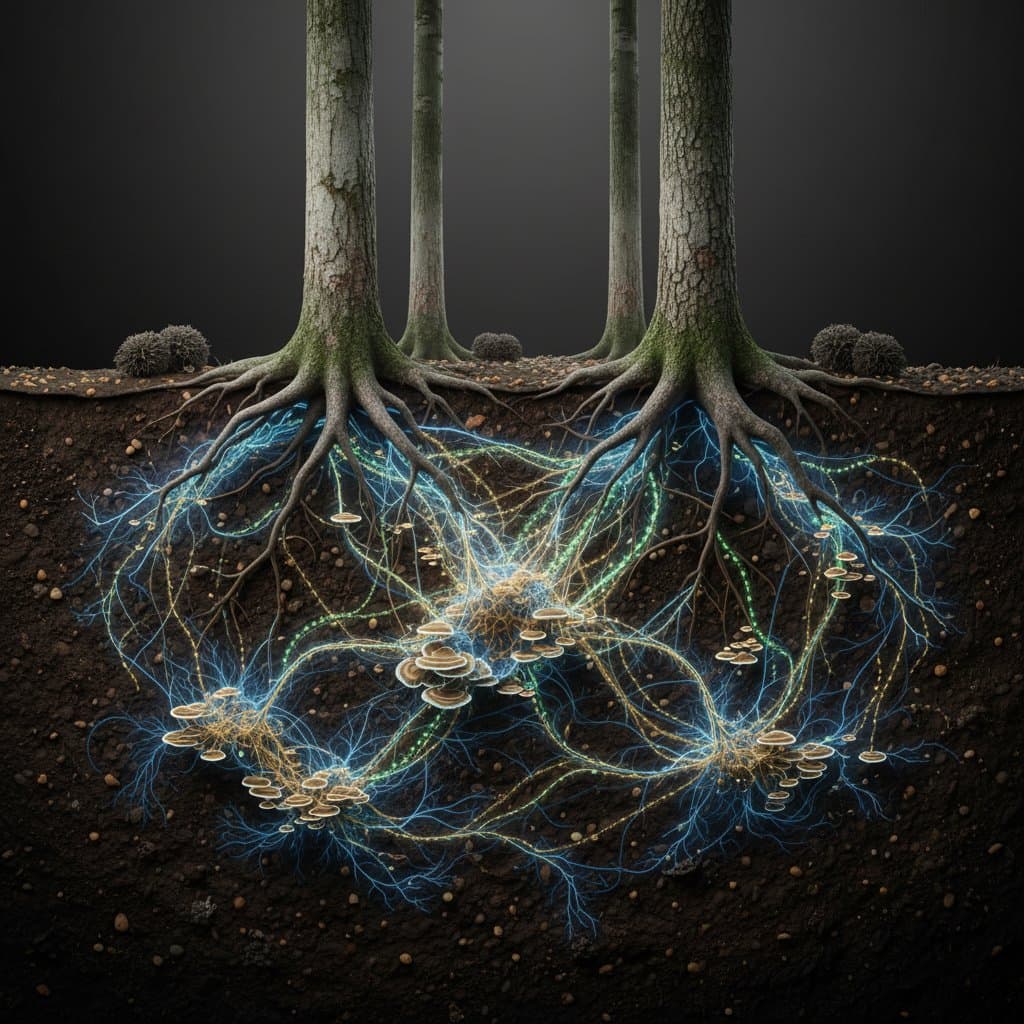
Mycelium Networks: Enhancing Tree Vitality Through Underground Connections
Trees draw strength from sunlight, water, and soil nutrients, yet a concealed fungal system plays an equally vital role. Mycelium networks, composed of fine fungal threads, interconnect roots across landscapes, enabling resource transfer and ecosystem support. Researchers in arboriculture, soil science, and environmental technology increasingly examine these networks to develop methods for cultivating them, thereby elevating tree health and landscape durability.
This article details the mechanics of mycelium networks, their impact on tree well-being, and practical applications of fungal ecology in modern soil management.
The Underground Fungal Web Supporting Trees
Mycelium represents the root-like structure of fungi, made up of slender hyphae that weave through soil and decaying material. These filaments create expansive subterranean systems that link multiple trees and plants, allowing for the exchange of essential substances and signals.
In a symbiotic association known as mycorrhizae, mycelium partners with tree roots to extend their foraging range for water and minerals beyond what roots achieve independently. Trees reciprocate by providing carbohydrates from photosynthesis. This exchange sustains forests in nutrient-poor or extreme environments, as evidenced by studies revealing network functions akin to an ecological communication grid.
Through these connections, trees distribute nutrients, alert others to threats like pests or drought, and modulate growth to reduce rivalry among plants.
Boosting Tree Vitality with Mycelium Networks
The robustness of a tree's mycorrhizal links directly influences its growth, disease resistance, and stress recovery. Mycelium networks deliver several critical advantages:
- Superior nutrient absorption: Hyphae access phosphorus, nitrogen, and micronutrients in distant or compacted soil layers.
- Greater tolerance to drought: Fungal structures retain water and refine soil porosity, aiding survival during prolonged dry spells.
- Defense against diseases: Select fungi suppress pathogens through competition or antimicrobial compounds.
- Carbon sequestration: Networks bind carbon into stable soil forms, aiding environmental balance and fertility.
- Communication across trees: Linked trees sense distress in neighbors and respond by altering defenses or resource allocation.
Categories of Mycelium Networks
Ectomycorrhizal Networks
Ectomycorrhizal fungi encase tree roots in a protective mantle while extending hyphae outward, without entering cells. They predominate in conifer, oak, and birch woodlands.
Advantages:
- Optimize exchange of phosphorus and nitrogen.
- Shield roots from infections.
- Build expansive, enduring connections among trees.
Disadvantages:
- Depend on particular host trees, restricting use in diverse settings.
- Vulnerable to disruption from soil tillage or compression.
Endomycorrhizal (Arbuscular) Networks
Endomycorrhizal fungi enter root cells to form nutrient-transferring arbuscules. They associate broadly with grasses, shrubs, and broadleaf trees.
Advantages:
- Versatile across plant types and soil conditions.
- Excel at phosphorus mobilization.
- Accelerate rooting in saplings.
Disadvantages:
- Offer weaker pathogen barriers compared to ectomycorrhizae.
- Exhibit shorter duration and smaller scale.
Saprotrophic Mycelium
Saprotrophic fungi break down lifeless organic debris rather than partnering with live roots. They contribute indirectly by releasing recycled nutrients.
Advantages:
- Elevate soil nutrient levels and humus.
- Degrade resilient materials such as lignin.
Disadvantages:
- Provide no direct root support.
- May vie with symbiotic fungi in low-organic environments.
Expenses and Practicality of Enhancing Mycelium
Average Costs Nationwide
Promoting mycelium development or applying inoculants proves economical relative to broader soil enhancements. Expenses typically cover testing, inoculants, and organic inputs, remaining accessible for residential use.
Costs Based on Project Scale and Scope
- Home garden improvements: Involve low to moderate outlays, scaled to existing soil and targeted fungi.
- Extensive restoration in landscapes or woodlands: Incur higher fees from bulk materials, assessments, and expert involvement.
- Inoculated planting for new trees: Add a small premium to routine costs, yielding enhanced establishment rates.
Influencing Cost Elements
- Selection of inoculant variety.
- Baseline soil quality and pollutant presence.
- Efforts in aeration or modification.
- Project magnitude and site accessibility.
- Ongoing care like mulching.
Choosing Between DIY and Professional Services
DIY Methods
Individuals can foster mycelium by incorporating inoculants, leaf litter, or fungal-enriched compost. These approaches save money and gradually enrich soil, contingent on local conditions like humidity and microbial balance.
DIY Limitations:
- Challenges in matching fungi to tree types.
- Potential for errors in watering or aeration that stifle growth.
- Absence of precise evaluation tools.
Professional Assistance
Experts such as certified arborists or ecologists evaluate soil profiles, pinpoint gaps in fungal diversity, and deploy precise interventions. They employ sophisticated testing and tailored inoculants for optimal results.
Professional Advantages:
- Thorough diagnostic analysis.
- Accurate deployment techniques.
- Alignment with comprehensive care strategies.
- Quicker and more consistent outcomes.
Guidance:
Opt for DIY in simple enrichments or compact areas. Engage professionals for established trees, degraded sites, or ambitious undertakings to secure robust networks.
Steps to Promote Mycelium Around Trees
1. Evaluate and Condition Soil
Conduct a soil analysis for pH, organics, and nutrients. Fungi favor balanced, non-synthetic-fertilized profiles. Amend pH organically if deviations occur.
2. Steer Clear of Fungicides and Chemicals
Such agents eliminate beneficial fungi indiscriminately. Rely on organic controls and minimize high-nitrogen inputs.
3. Incorporate Organic Materials
Spread generous layers of untreated leaves, chips, or compost. These sustain fungi and enhance soil aggregation.
4. Apply Fungal Inoculants
Use products with viable spores or fragments, applying to roots at planting or blending into surface soil for veterans.
5. Ensure Proper Hydration and Oxygenation
Fungi require damp, loose soil. Irrigate thoroughly yet sparingly, and prevent compaction near roots.
6. Foster Biodiversity
Incorporate diverse understory plants to nurture varied fungal interactions and ecosystem stability.
7. Retain Natural Debris
Allow light accumulations of leaves or wood to supply ongoing nourishment and regulate microclimates.
Strategies for Sustained Tree Health via Mycelium
- Minimize root-zone disruption: Refrain from excavation to preserve hyphal integrity.
- Apply organic nutrients: Use composts that nourish without toxicity.
- Track hydration levels: Maintain even moisture to avoid extremes.
- Diversify mulch varieties: Promote fungal multiplicity.
- Favor local flora: They align with indigenous mycelial communities.
Common Questions on Mycelium and Trees
How can one detect active mycelium in soil?
Look for whitish strands beneath mulch, alongside friable texture and a rich aroma. Laboratory assays provide definitive verification.
Is cultivating mushrooms beneficial for tree soil?
Select species can enrich structure and organics, provided they do not overshadow mycorrhizal allies.
Do mycorrhizal fungi aid every tree species?
Nearly all benefit, with preferences varying: ectomycorrhizae suit conifers and oaks, endomycorrhizae favor maples and fruits.
Are inoculants harmless to animals?
Commercial options generally pose no risk, especially those free of additives; they integrate naturally.
Can mycelium rehabilitate urban soils?
It excels at remediating contaminants, firming aggregates, and reviving biology in altered terrains.
When is reapplication of inoculants necessary?
Typically once at initiation; renew after disturbances like erosion or treatments.
Cultivating Resilient Landscapes with Mycelium
Integrating mycelium support stands as a straightforward, economical path to tree enhancement. From modest plots to vast grounds, these efforts yield enduring, self-regulating benefits.
Initiate with assessments and organics, followed by suitable inoculants. Safeguard progress through chemical avoidance and steady care. Trees will exhibit vigorous expansion, vivid foliage, and superior endurance.
Seek expert input for intricate scenarios to match fungi precisely to your environment, guaranteeing lasting vitality and aesthetic appeal.
Beneath vibrant canopies, root-fungal symbioses form the foundation of endurance. Nurturing this alliance secures landscapes that flourish progressively.