
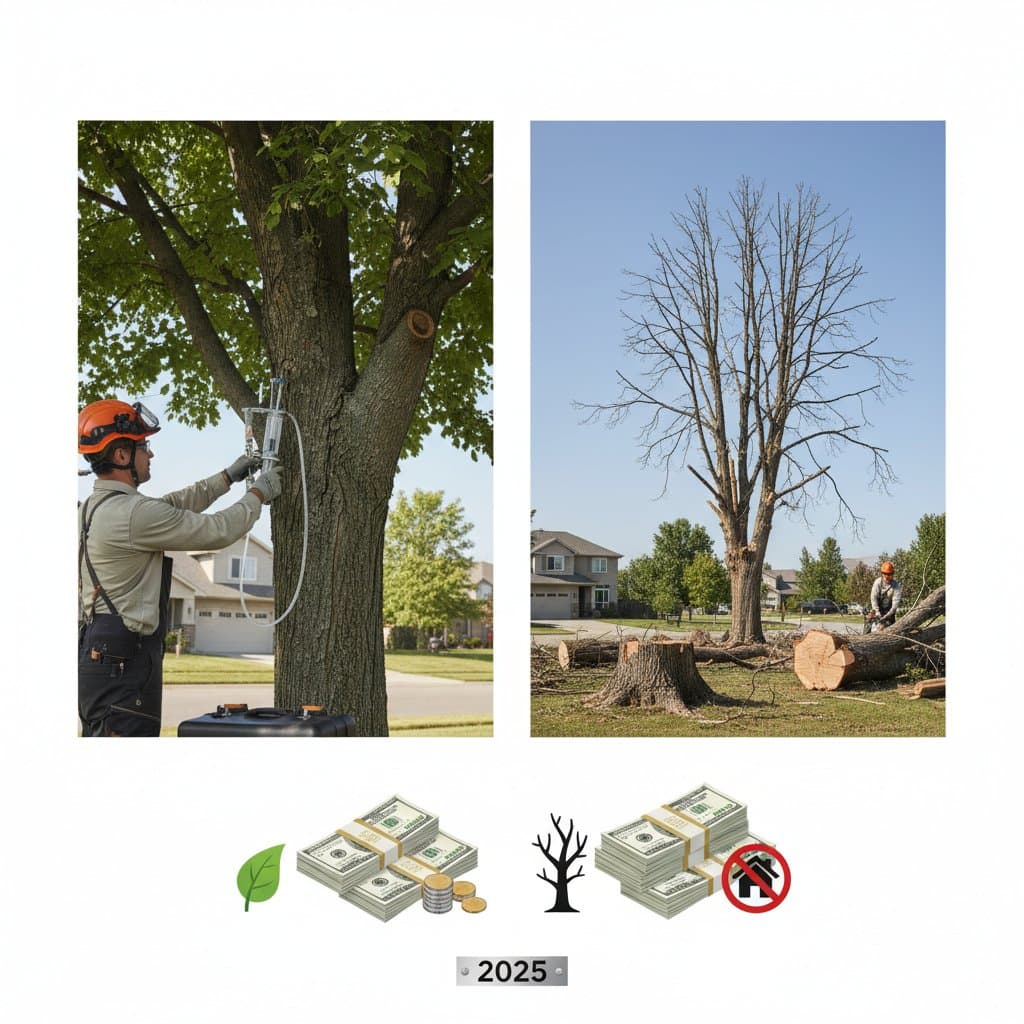
2025 Costs: Inject Ash Trees or Remove Them?
Ash trees provide essential shade and enhance property aesthetics, yet the emerald ash borer (EAB) endangers countless specimens. Property owners must weigh ongoing insecticide injections against complete removal, considering financial outlays, ecological impacts, and structural risks. This analysis details the cost to inject ash trees versus the cost to remove them, equipping you with data to decide confidently for your landscape.
What Is Ash Tree Injection?
Ash tree injection delivers targeted protection from the emerald ash borer. A licensed arborist administers insecticide into the tree's vascular tissue, enabling distribution to the trunk, limbs, and foliage. This approach eliminates current larvae and blocks future invasions. Properly executed, it sustains a vigorous ash tree for multiple years.
Average Costs to Inject or Remove an Ash Tree
Expenses for ash tree treatment or removal fluctuate based on dimensions, health status, and site specifics. The average cost to inject an ash tree falls between $150 and $500 per tree. In contrast, the average cost to remove an ash tree spans $400 to $2,500, influenced by stature and site access.
| Factor | Average Injection Cost | Average Removal Cost |
|---|---|---|
| Small Tree (under 30 ft) | $150 - $250 | $400 - $700 |
| Medium Tree (30-60 ft) | $250 - $400 | $700 - $1,500 |
| Large Tree (over 60 ft) | $400 - $500 | $1,500 - $2,500 |
These figures reflect national benchmarks. Regional variations arise from labor rates, waste disposal charges, and arborist availability.
Factors Affecting the Cost to Treat or Remove an Ash Tree
Tree Size
Greater height demands increased insecticide volume, extended labor, and enhanced safety measures. For instance, a towering ash tree might necessitate aerial lifts or rigging systems, elevating expenses for both injection and removal.
Tree Condition
Vigorous ash trees respond well to treatment with minimal cost. EAB-compromised trees exhibit vascular blockages that hinder injection efficacy. Trees with extensive dieback or limb instability often warrant removal to avert collapse risks.
Tree Species
Varieties like green ash or white ash vary in treatment response. Certain types uptake insecticides swiftly, allowing less frequent applications. Others necessitate annual or biennial dosing to maintain defenses.
Location and Accessibility
Proximity to utilities, structures, or terrain obstacles complicates operations. Restricted sites require cranes or additional crew, inflating costs for injections and removals alike.
Urgency
Immediate action on hazardous trees incurs surcharges. Arborists apply higher fees for weekend, nighttime, or expedited interventions compared to routine scheduling.
Local Regulations
Certain areas enforce EAB containment protocols, including mandatory treatments or removal permits. Associated fees and inspections add to overall expenditures.
The Ash Tree Injection Process
-
Inspection and Assessment
An arborist evaluates vitality, identifies EAB indicators like galleries under bark, and determines treatment suitability. -
Cost Estimate and Scheduling
The professional delivers a quote based on trunk diameter or tree count. Upon agreement, a date is set, ideally during active growth periods. -
Preparation and Setup
Small apertures are drilled at trunk base, spaced by diameter measurements. Injection ports secure the delivery system. -
Injection of Insecticide
Pressurized tools introduce the chemical into sap flow paths. Completion occurs within one to two hours for most specimens. -
Cleanup and Monitoring
Ports seal naturally, and sites restore to original condition. Follow-up inspections occur annually to gauge efficacy and plan reapplications every one to three years.
The Ash Tree Removal Process
-
Initial Assessment and Quote
The arborist measures dimensions, assesses lean direction, and notes hazards, then issues a precise estimate. -
Permitting and Utility Checks
Required approvals obtain, and lines for power, water, or gas verify clearance to prevent disruptions. -
Tree Felling or Sectional Dismantling
In confined spaces, limbs section progressively with ropes guiding descent. Open areas permit directional felling for efficiency. -
Stump Grinding
Post-felling, stumps grind to soil level at $100 to $300 extra, facilitating replanting or turf restoration. -
Debris Cleanup and Disposal
Materials haul away or chip on-site per preference, ensuring property tidiness and regulatory adherence.
DIY vs. Hiring a Professional
When DIY Might Be Possible
- Apply soil drenches to saplings under 10 feet using over-the-counter systemic products.
- Trim accessible deadwood with sterilized pruners to reduce minor pest harbors.
Such efforts suit low-risk, diminutive trees. Adhere strictly to label guidelines and verify no local bans on chemicals.
When to Hire a Professional
- Any tree exceeding 20 feet or adjacent to infrastructure.
- Specimens displaying EAB signs, including woodpecker activity or serpentine tunnels.
- Tasks involving heights, machinery, or potent insecticides.
Certified experts possess certifications, coverage, and expertise to minimize liabilities and maximize outcomes.
How to Hire a Tree Service
-
Check Credentials and Insurance
Verify International Society of Arboriculture certification and full coverage against property damage or injuries. -
Ask for References
Request client testimonials or review platforms like Better Business Bureau for performance insights. -
Get Multiple Estimates
Solicit bids from three providers, scrutinizing inclusions like travel fees or overtime. -
Confirm Details in Writing
Contracts delineate services, timelines, payments, and contingencies for weather delays. -
Discuss Long-Term Care
For treatments, outline maintenance schedules. For removals, explore replacement species resistant to EAB.
Frequently Asked Questions
How Much Does It Cost to Remove a 50-Foot Ash Tree?
A 50-foot ash tree removal generally ranges from $900 to $1,600. Factors such as urban setting, stump processing, and branch volume dictate the final amount.
Is It Cheaper to Inject an Ash Tree or Remove It?
Initial injections prove more economical, at $300 for medium trees versus over $1,000 for removal. Long-term viability hinges on infestation stage; advanced cases favor extraction to avoid repeated failures.
What Time of Year Is Best for Ash Tree Injection?
Spring through early summer aligns with sap ascent, optimizing chemical uptake. Avoid dormant seasons when translocation slows.
Does Homeowners Insurance Cover Ash Tree Removal?
Coverage applies to storm-fallen trees damaging insured elements. Proactive removals of upright trees fall outside standard policies.
How Long Do Ash Tree Injections Last?
Effective protection spans one to three years, varying by formulation, tree vigor, and pest pressure. Annual checks ensure timely renewal.
Can an Infested Ash Tree Be Saved?
Early detection with under 30 percent canopy loss permits recovery via injections. Beyond 50 percent decline, structural integrity compromises necessitate removal.
Weighing Options for Sustainable Landscape Management
Evaluate ash tree health through professional diagnosis to align choices with fiscal and aesthetic priorities. Preserve viable specimens with proactive injections to retain ecological benefits. Remove irreparable ones swiftly to mitigate dangers and enable resilient replanting. Expert consultation ensures balanced decisions that enhance property value and environmental stewardship.