
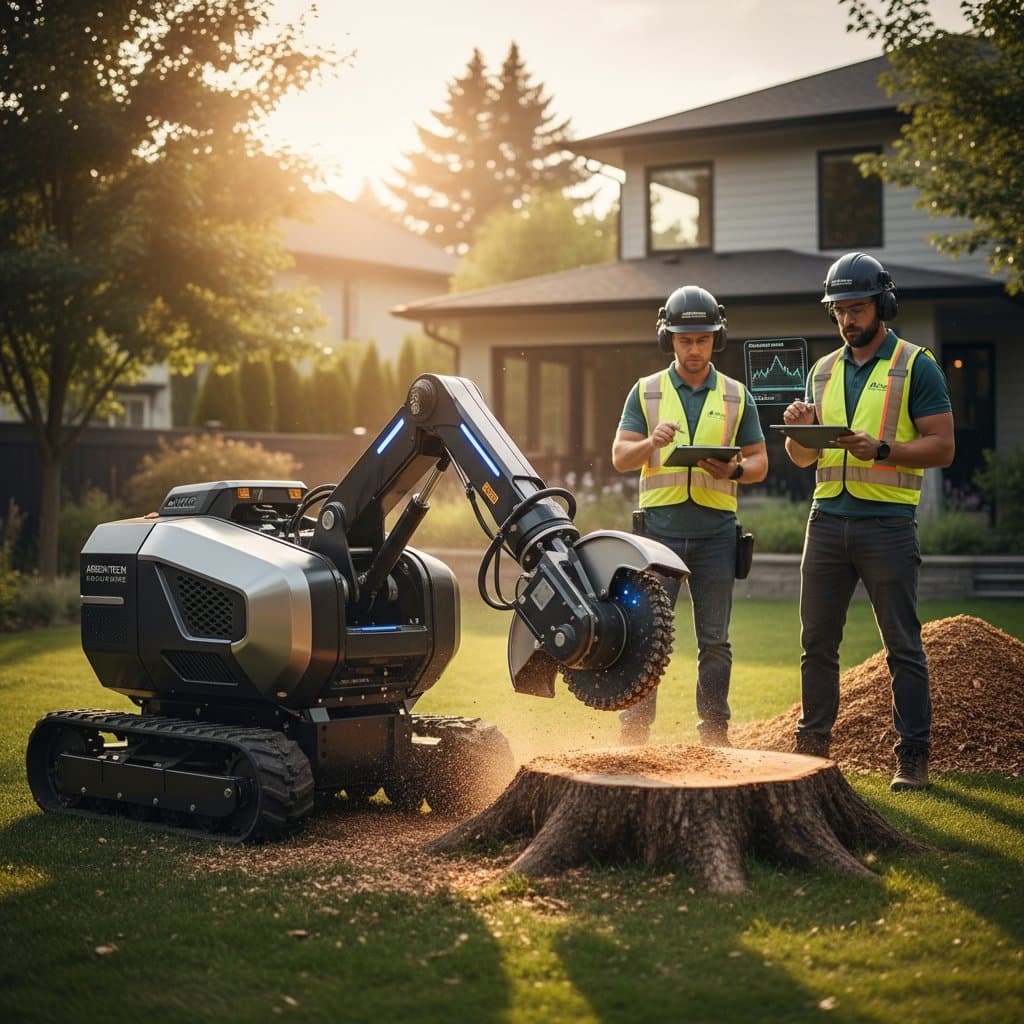
Robotic Stump Grinders: Cutting Labor Costs in Half for Tree Removal
Tree stump removal ranks among the most demanding tasks in tree care and land clearing. Robotic stump grinders change this landscape by reducing labor costs by nearly 50 percent, while enhancing precision and safety. Professionals now rely on this automated equipment for quicker results and reliable performance across diverse sites.
This guide details the operation of robotic stump grinders, their costs, and comparisons to conventional methods. It also evaluates options for renting, purchasing, or engaging services, helping homeowners and contractors realize significant savings.
Robotic Stump Grinder Costs
National Average Costs
The typical expense for stump removal with a robotic grinder ranges from 200 to 400 dollars per stump, based on size and site access. For extensive commercial or multi-stump projects, overall costs span 1,000 to 3,000 dollars. Robotic grinders shorten labor duration by about 50 percent compared to manual or operator-controlled units, lowering overall project expenses.
Costs by Project Scale or Category
- Single Residential Stump: 200 to 400 dollars
- Multiple Residential Stumps: 500 to 1,200 dollars
- Commercial or Municipal Projects: 1,000 to 3,000 dollars or higher
- Equipment Rental: 300 to 600 dollars daily, varying by model and location
Primary Cost Influences
- Stump Dimensions and Wood Density: Bigger or harder stumps demand extended grinding periods.
- Site Accessibility: Confined areas or uneven slopes might necessitate extra preparation or compact robotic models.
- Machine Category: Fully autonomous versions involve higher initial investment but yield the greatest labor reductions.
- Energy Type: Electric units operate quietly with minimal upkeep, whereas gas models manage demanding tasks.
- Supervision Requirements: Certain systems demand limited oversight, impacting job expenses.
- Local Market Factors: Regional wages and regulatory needs shape final costs.
Categories of Robotic Stump Grinders
Semi-Autonomous Models
These devices employ sensors and preset controls to direct the cutting wheel with limited human intervention.
- Advantages: Cost-effective starting option, straightforward handling, effective on irregular surfaces.
- Drawbacks: Requires ongoing monitoring, operates more slowly than full automation.
Fully Autonomous Models
Advanced units integrate GPS navigation, lidar detection, and integrated processors to process stumps without assistance.
- Advantages: Optimal productivity, reduced workforce needs, uniform accuracy, elevated safety.
- Drawbacks: Elevated acquisition price, demands skilled configuration and servicing.
Remote-Operated Systems
Operators control these grinders from a secure distance via wireless devices, away from the work area.
- Advantages: Lowers personal hazard exposure, suitable for risky landscapes, easy to transport.
- Drawbacks: Needs continuous operator focus, proceeds more gradually than self-directed units.
Compact Automated Add-Ons
These robotic features connect to base machinery like skid steers or excavators, incorporating intelligent sensors for automation.
- Advantages: Versatile application, leverages current tools, reasonable pricing.
- Drawbacks: Relies on host equipment capacity, offers partial independence.
DIY Approaches Versus Professional Services
Handling Projects Independently with Robotic Tools
Homeowners comfortable with technology may consider renting robotic stump grinders to streamline the task. These machines ease the grinding process, yet demand proper installation, adjustment, and caution.
Key difficulties involve:
- Grasping control interfaces and site mapping functions.
- Addressing waste materials and subsurface barriers.
- Coordinating transport and post-use maintenance.
Engaging Expert Assistance
Specialized tree firms equipped with robotic grinders finish tasks in half the usual time using smaller teams. Experts assess root extent, ground stability, and utility locations with proficiency. They manage waste removal and area recovery as well.
Primary gains encompass:
- Secure execution and diminished risk exposure.
- Reliable outcomes and accelerated completion.
- Utilization of premium equipment without rental or training demands.
Step-by-Step Stump Removal with a Robotic Grinder
-
Assess and Quantify the Stump
Determine diameter, root extent, and closeness to buildings or lines. -
Prepare the Area
Remove obstacles, indicate buried utilities, and confirm level ground for the device. -
Configure the Machine
Enter measurements and target removal depth. Align detection systems for precision. -
Initiate the Process
The unit self-locates and grinds progressively through layers. -
Observe Operations
Remain in proximity to verify safety and modify parameters as necessary. -
Manage Waste Materials
After completion, clear fragments and backfill with soil or covering. -
Confirm Full Removal
Check for remaining roots before planting or sodding.
Strategies for Cost Reduction and Peak Performance
- Integrate Multiple Tasks: Pair stump work with pruning or clearing to minimize labor charges.
- Select Electric Variants: These demand less energy and servicing.
- Facilitate Entry: Verify vehicle and equipment access to prevent delays.
- Time Projects Strategically: Opt for quieter seasons when providers extend rate reductions.
- Preserve Site Conditions: Eliminate stones and litter to avoid disrupting detection features.
Common Questions on Robotic Stump Grinders
In What Ways Do Robotic Stump Grinders Lower Labor Expenses?
These devices automate the majority of the grinding, enabling a single person to oversee multiple units simultaneously. Such productivity halves personnel requirements and compresses project timelines.
Do Robotic Stump Grinders Suit Home Settings?
Affirmative, with built-in safeguards that identify hurdles and halt operations. They prove ideal for home lots emphasizing accuracy and protection.
Is Weekend Rental of a Robotic Stump Grinder Feasible?
Rental outlets frequently stock semi- or fully automated options for brief periods. Select appropriately for stump scale and study operational guidelines thoroughly.
What Maintenance Applies to Robotic Stump Grinders?
Standard care covers blade inspections, sensor tuning, debris clearance, and software updates. Electric types generally need less attention than fuel-based ones.
Can Robotic Grinders Process Every Wood Variety?
They manage soft and hard woods capably. Dense or sticky types extend processing time, yet automated control guarantees thorough elimination.
Are Robotic Grinders Beneficial for the Environment?
Numerous models feature electric drives that cut pollution and sound. Their exactness limits ground disturbance, surpassing traditional grinders in sustainability.
Implementing Robotic Solutions for Your Project
Robotic stump grinders reshape tree removal finances by halving labor outlays, alongside gains in safety and uniformity. Homeowners tackling isolated stumps or contractors preparing vast areas benefit from accelerated workflows and decreased expenses. Professionals equipped with these tools deliver the most efficient path forward for property managers.