
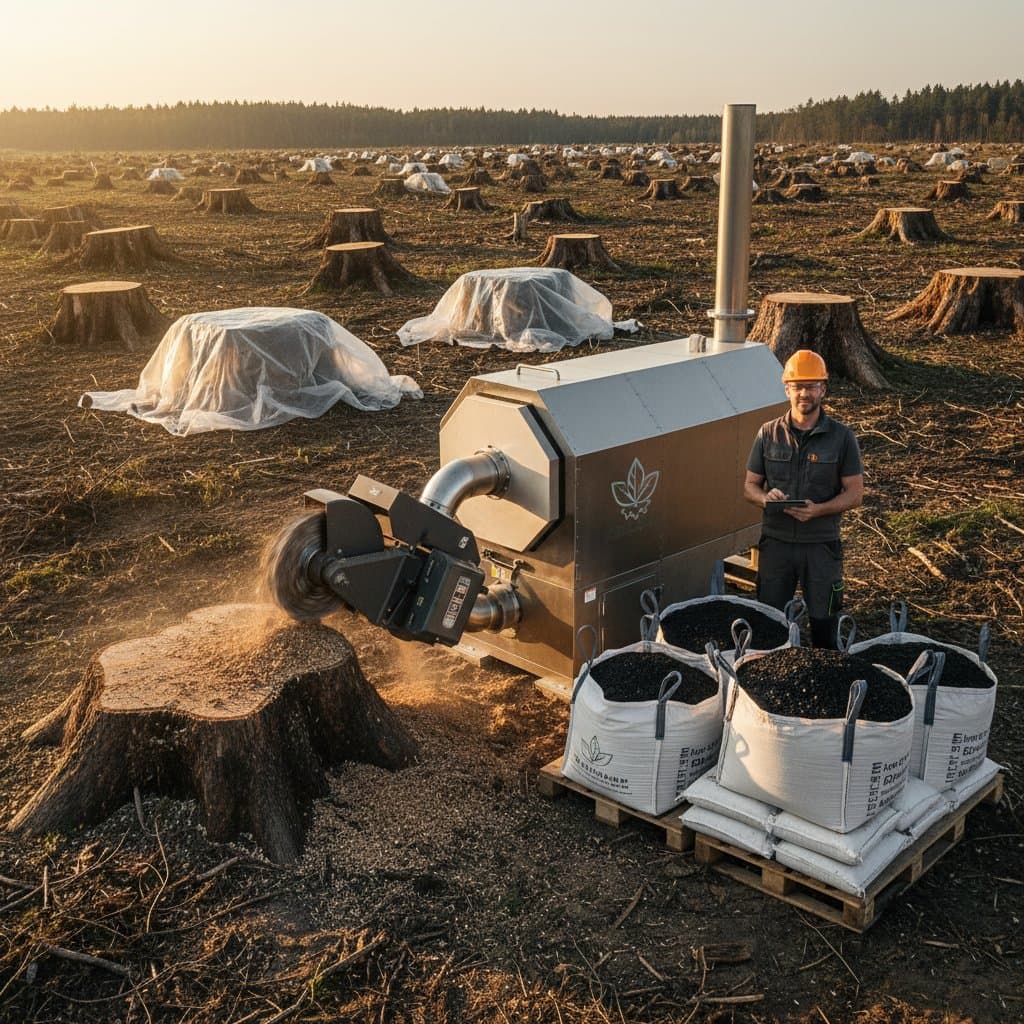
Turn Tree Stumps into $500+ Biochar for Big Profits
Tree stumps often appear as mere remnants after removal, yet they possess significant potential when converted into biochar. This high-carbon material serves as an effective soil enhancer, allowing homeowners and small contractors to transform waste into a renewable product valued at hundreds of dollars. The following guide details the process of producing biochar from tree stumps, including associated costs, equipment choices, and essential steps for effective implementation.
Biochar from Tree Stumps: The Basics
Biochar consists of charcoalbiomass, such as wood, in an environment with limited oxygen. Known as pyrolysis, this method stabilizes carbon in a form that persists in soil for centuries. Biochar enhances soil fertility, boosts water retention, and mitigates greenhouse gas emissions. Tree stumps, characterized by dense wood and elevated carbon levels, provide ideal feedstock for generating superior biochar.
Rising interest in sustainable soil amendments drives demand for biochar. Gardeners, landscapers, and farmers readily purchase locally produced biochar that promotes soil vitality and carbon storage.
Biochar Production Costs
National Average Costs
The expense of producing biochar from tree stumps ranges from minimal amounts per pound to negligible levels with existing equipment. Primary costs involve stump collection, grinding, processing, and energy for pyrolysis. Typically, one cubic yard of stump wood yields 100 to 150 pounds of biochar, with market values surpassing $500 per batch.
Costs by Project Scale or Setup
- Small-Scale DIY Setup: Initial outlay remains low using a homemade kiln or adapted metal drum, often totaling a few hundred dollars.
- Mid-Scale Operation: A compact commercial kiln or retort system demands an investment of several thousand dollars, enabling larger, uniform batches.
- Professional Operation: Those already engaged in stump grinding integrate biochar production at little additional cost, converting waste into revenue.
Key Cost Influences
- Stump Grinding and Preparation: Reducing stumps to chips for pyrolysis.
- Equipment: Options like kilns, retorts, or pyrolysis units differ substantially in price.
- Labor: Efforts in processing, loading, and overseeing burns.
- Energy Source: Requirements for propane, wood gas, or electricity to generate heat.
- Packaging and Marketing: Materials such as bags, labels, and branding for distribution.
Biochar Production Methods
Flame Cap Kiln
This design features an open-top cone or pit where wood burns downward from the top, restricting oxygen to retain carbon.
Advantages:
- Inexpensive construction and simplicity.
- Appropriate for modest quantities.
- Facilitates production directly at the site.
Disadvantages:
- Demands vigilant oversight.
- Yields vary if airflow control falters.
Retort Kiln
In this system, biomass resides in a sealed chamber heated externally, yielding consistent, high-grade biochar.
Advantages:
- Reduced smoke from efficient combustion.
- Reliable product uniformity.
- Suited for business applications.
Disadvantages:
- Elevated initial expense.
- Necessitates technical expertise.
Gasifier System
This apparatus transforms biomass into usable gases for powering equipment or electricity, with biochar as a secondary output.
Advantages:
- Multifunctional with energy capture.
- High carbon preservation rates.
- Adaptable to expanded operations.
Disadvantages:
- Intricate operation and upkeep.
- Substantial setup and ongoing costs.
DIY Approaches Versus Professional Services
Producing biochar from stumps suits DIY enthusiasts, though challenges exist. Homeowners may begin with a basic flame cap kiln or modified drum, perfect for personal or limited output. Such methods conserve funds and foster practical knowledge.
Professionals equipped with grinders and processors achieve greater efficiency. They handle multiple stumps simultaneously, ensuring steady supply for markets. For those managing extensive stumps, engaging experts minimizes safety concerns and regulatory hurdles tied to burning and emissions.
Homeowners aiming for income might collaborate with tree removal firms. These partners supply materials, while the individual manages conversion and distribution.
Steps to Convert Tree Stumps into Biochar
1. Gather and Prepare Stumps
Extract stumps via grinding or excavation. Allow wood to air-dry for weeks to lower moisture, promoting efficient burning and superior biochar quality.
2. Process into Chips or Pieces
Divide stumps into small segments or chips, targeting sizes under a few inches for uniform pyrolysis heating.
3. Assemble or Position the Kiln
Choose based on intended volume. A perforated metal drum suffices for small loads; cone kilns or retorts handle greater amounts.
4. Charge the Kiln
Pack with chips or chunks. Ignite from the top to direct flames downward, minimizing oxygen contact and maximizing carbon retention.
5. Oversee the Pyrolysis
Observe smoke transitions. Clear smoke and even charring signal completion; extinguish with water or by sealing to halt oxygen.
6. Cool and Process Further
Permit full cooling prior to manipulation. Break into finer particles to simplify soil or compost integration.
7. Activate the Biochar
Prior to application or sale, blend with compost tea or nutrient solutions. Activation prevents nutrient depletion in soils upon use.
Strategies for Effective Biochar Production
- Prioritize Safety: Employ gloves, protective eyewear, and suitable attire at all times.
- Select Dry Materials: Excess moisture hampers efficiency and generates unnecessary smoke.
- Control Ventilation: Excessive air converts biochar to ash; balance is essential.
- Evaluate Mixtures: Incorporate biochar into compost or soil samples and assess outcomes before commercialization.
- Record Procedures: Track methods, inputs, and yields to refine future batches.
Frequently Asked Questions
How Much Biochar Yields from One Tree Stump?
A sizable stump generates 10 to 20 pounds, varying by dimensions and wood type. Dense hardwoods produce greater quantities than soft varieties.
What Equipment Is Required for Biochar?
Basic items like a modified drum or barrel initiate production. For commercial scales, a retort kiln offers superior regulation and output.
Is Biochar Suitable for Residential Gardens?
Yes, when correctly produced and activated, it benefits gardens by refining soil texture, retaining moisture, and optimizing nutrients without risks.
Can Homemade Biochar Be Marketed?
Certainly, provided it adheres to quality benchmarks. Target audiences encompass gardeners, landscapers, and modest farms; include packaging with nutrient details to appeal.
Does Biochar Production Benefit the Environment?
Indeed, it sequesters carbon long-term, averting atmospheric release as dioxide. Additionally, it bolsters soil conditions and diminishes reliance on chemical fertilizers.
Build Income from Stump Conversion
Tree stumps warrant repurposing rather than disposal or decay. Equipped with appropriate tools and techniques, individuals convert them into valuable assets. Biochar production merges ecological advantages with financial gains, empowering homeowners and enterprises to profit while advancing sustainability.
To commence, liaise with regional tree services for stump access or align with landscapers for wood processing. Each biochar batch advances environmental stewardship and revenue potential.