
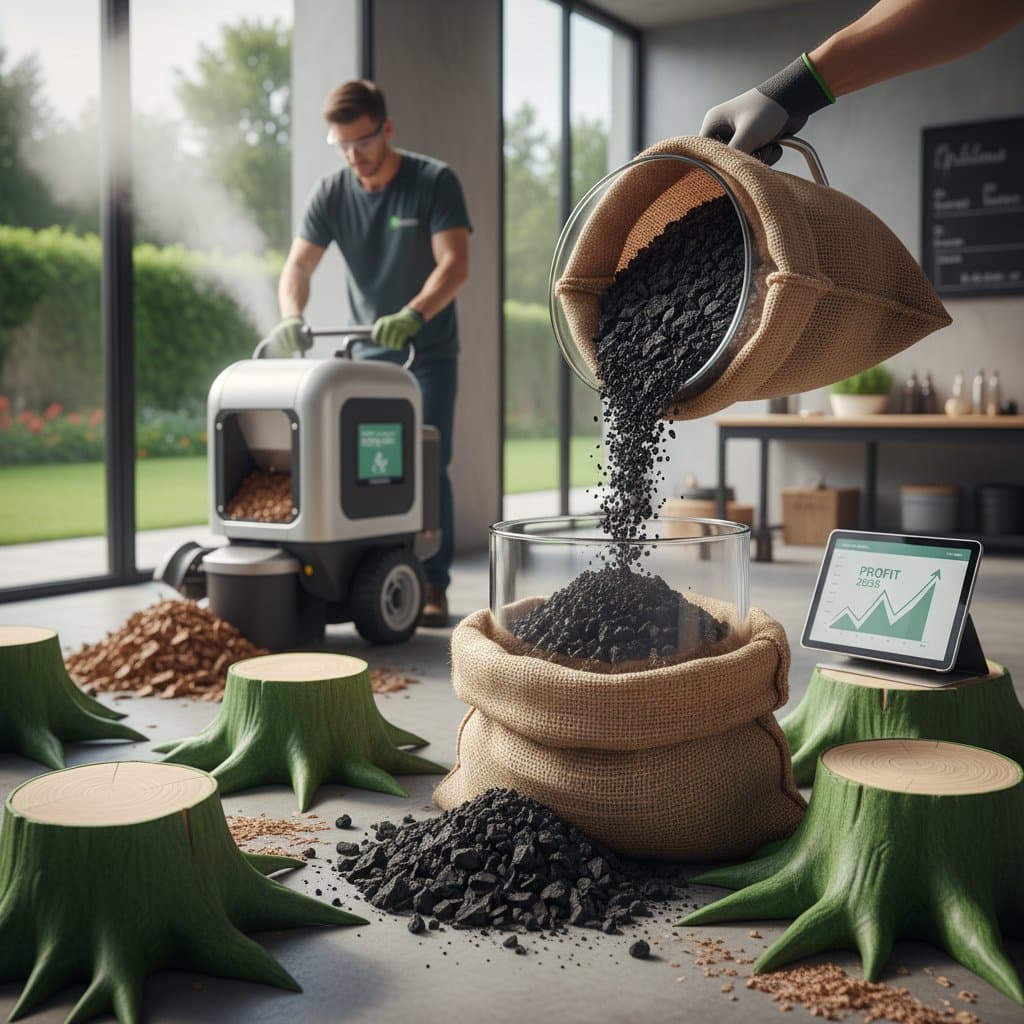
Turn Stump Waste into Biochar Revenue by 2026
Tree stumps often represent a costly disposal challenge for homeowners and tree service professionals. Converting this waste into biochar offers a practical path to revenue generation and environmental benefits. By 2026, advancements in processing technology and growing market demand position biochar as a viable addition to tree care operations.
This guide outlines the process, equipment options, and economic considerations for transforming stump grindings into a carbon-rich soil amendment. Professionals can integrate biochar production to offset costs, enhance sustainability, and attract eco-conscious clients. The result supports long-term business growth while contributing to soil health and carbon sequestration.
What Is Biochar and Why Produce It from Stumps?
Biochar results from heating organic material, such as stump grindings, in a low-oxygen environment through pyrolysis. This process yields a stable, charcoal-like substance rich in carbon. Unlike traditional charcoal, biochar serves primarily as a soil enhancer rather than a fuel.
Incorporating biochar into soil improves water retention, minimizes nutrient leaching, and fosters beneficial microbial communities. It sequesters carbon for centuries, aiding in climate mitigation efforts. For tree care businesses, producing biochar from stumps recycles waste that might otherwise incur landfill fees, creating value from an overlooked resource.
Factors Affecting Biochar Production Profitability
Several elements determine the financial viability of biochar from stump waste. Evaluating these helps in scaling operations effectively.
-
Material Volume: Consistent access to stumps ensures steady production. Tree services handling multiple jobs weekly benefit most, as they generate sufficient grindings for regular batches.
-
Equipment Scale and Cost: Entry-level pyrolysis units start at $5,000 for portable models processing 50-100 pounds per batch. Industrial systems, costing $50,000 or more, handle tons daily and suit high-volume operations.
-
Market Pricing: Biochar sells for $1-3 per pound retail, higher than standard mulch at $0.50 per pound. Target local nurseries, organic farms, or gardeners seeking premium soil products.
-
Energy Efficiency: Advanced units capture syngas for reheating, cutting fuel needs by up to 30%. This feature boosts margins on larger setups.
-
Operational Costs: Factor in grinding time, transport to processing sites, and labor at $20-40 per hour. Streamline by processing on-site where possible.
Step-by-Step Guide to Producing Biochar from Stumps
The conversion process requires careful execution to maximize yield and safety. Follow these stages to produce high-quality biochar.
-
Grind the Stump: Employ a stump grinder with a 25-horsepower engine to create uniform chips under 2 inches in size. Smaller particles ensure even pyrolysis and higher carbon content.
-
Prepare the Material: Air-dry grindings for 24-48 hours to reduce moisture below 20%. This step prevents excessive smoke and improves energy efficiency during heating.
-
Conduct Pyrolysis: Load dried chips into a sealed kiln heated to 800-1000 degrees Fahrenheit for 2-4 hours. Monitor temperature to achieve complete carbonization without combustion.
-
Cool and Quench: Remove biochar and cool it in a covered container for 12 hours. Quench with water if needed to halt any residual heat.
-
Activate for Use: Soak biochar in a compost tea solution for 24 hours to infuse nutrients. This 'charging' enhances its soil performance and market appeal.
DIY Biochar Production Versus Professional Services
Homeowners with occasional stump removal may opt for simple DIY methods, while businesses benefit from professional integration.
For DIY, acquire a basic retort kiln for $500-1,000. Operate it in an open area, following fire safety protocols like having a fire extinguisher nearby. This approach suits small-scale garden applications, yielding 10-20 pounds per batch.
Professional services involve contracting with certified processors who handle compliance and quality control. Costs range from $0.50-1.00 per pound processed, but they offer scalability and certification for carbon credits. Businesses save time and access bulk sales channels.
Indicators That Biochar Production Fits Your Operation
Assess your situation to determine readiness for biochar initiatives.
- Frequent stump grinding generates 500+ pounds of waste monthly.
- Current disposal fees exceed $100 per load to landfills or composting sites.
- Clients prioritize organic or regenerative landscaping practices.
- Available space allows for safe, ventilated processing equipment.
- Interest exists in diversifying services toward sustainability consulting.
Meeting three or more of these signals strong potential for biochar to enhance operations.
Selecting Appropriate Biochar Production Equipment
Match equipment to your specific needs for optimal results. Consider these criteria during evaluation.
-
Throughput Capacity: Select units processing 200-500 pounds per cycle for mid-sized tree services.
-
Energy Recovery Features: Prioritize models with integrated gas burners to reuse byproducts, reducing propane use by 40%.
-
Mobility Options: Towable trailers enable on-site processing, minimizing transport logistics for remote jobs.
-
Safety Mechanisms: Ensure automatic shutoffs and filtration systems comply with EPA emission standards.
-
Maintenance Simplicity: Choose stainless-steel components for durability and easy cleaning after 50 cycles.
Frequently Asked Questions on Stump-Derived Biochar
Which Tree Species Work Best for Biochar?
Most species produce effective biochar, though hardwoods like maple yield denser material with greater porosity. Softwoods such as cedar create lighter biochar suited for quick soil integration. Avoid stumps treated with chemicals to prevent contaminant release.
Is Home Biochar Production Safe?
Yes, when conducted outdoors with windbreaks and at least 50 feet from structures. Use heat-resistant gloves and respirators; never process indoors. Consult local fire codes before starting.
What Revenue Potential Exists for Tree Services?
A mid-sized operation processing 1 ton monthly at $2 per pound nets $3,000 after $500 in costs. Scale to 5 tons for $15,000 monthly, factoring in direct sales to landscaping firms.
How Does Biochar Affect Different Soils?
In sandy soils, it increases water-holding capacity by 20%. Clay soils experience improved drainage and root penetration. Test soil pH first, as biochar raises alkalinity over time.
What Environmental Gains Come from Stump Biochar?
Producing 1 ton sequesters 2-3 tons of CO2 equivalent, offsetting emissions from grinding equipment. It diverts waste from landfills, reducing methane production by 90% compared to decomposition.
How Durable Is Biochar in Soil?
Its porous structure persists for 100-1,000 years, gradually releasing stored nutrients. Regular applications every 2-3 years maintain benefits in high-use areas.
Implementing Biochar to Build Sustainable Revenue Streams
Start by auditing your stump waste volume over the next quarter. Invest in a pilot pyrolysis unit to test yields and local sales. Track metrics like production costs and client feedback to refine your approach.
By 2026, biochar markets project 15% annual growth, driven by regenerative agriculture trends. Integrate this practice to position your business as a leader in eco-friendly tree care. The dual rewards of profit and planetary impact make it a strategic move worth pursuing.