
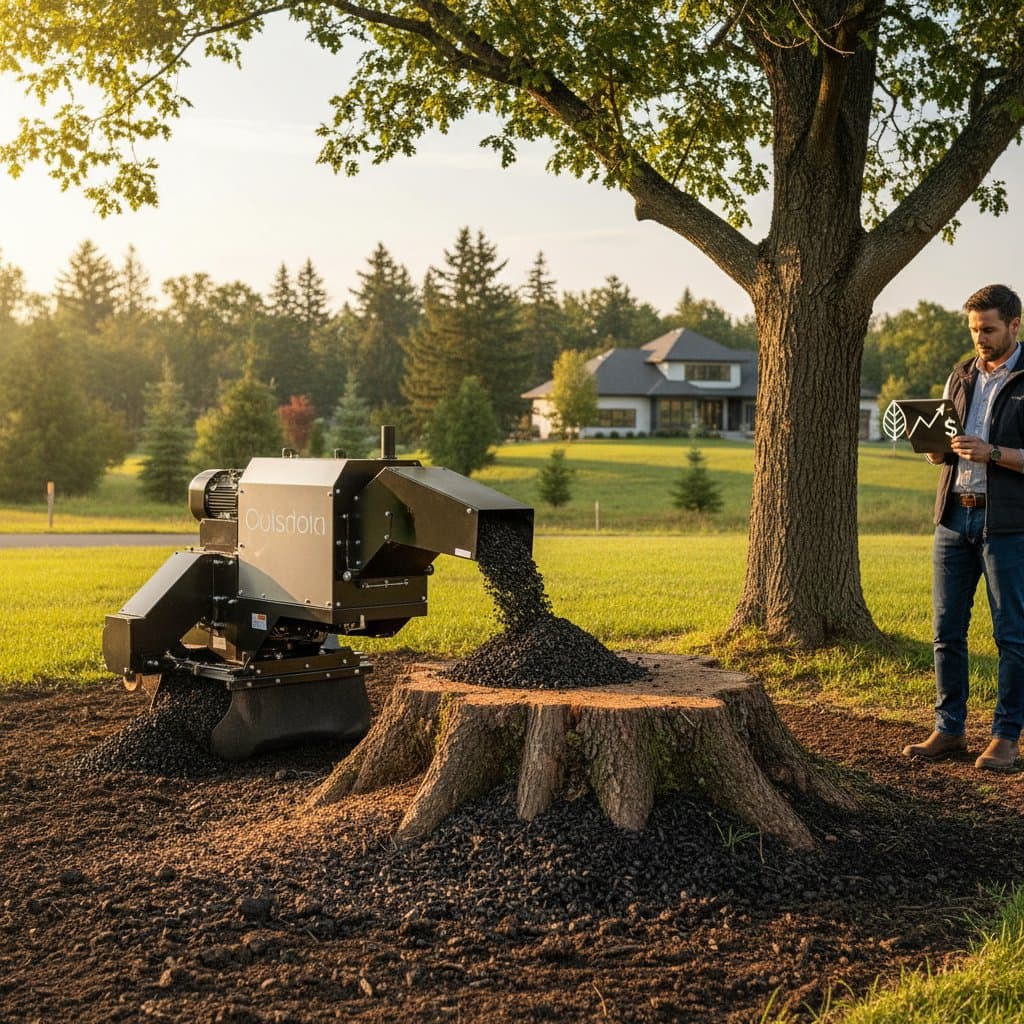
Unlocking Carbon Storage Through Biochar Stump Grinding
Tree stump removal traditionally involves grinding the wood into chips for disposal or mulching, often leading to carbon release through decomposition or incineration. Biochar stump grinding offers a superior alternative by processing stumps into biochar, a resilient carbon form that qualifies for carbon credits. This method integrates effective land clearing with climate mitigation, delivering benefits to property owners and ecosystems alike.
This article details the biochar stump grinding process, its role in carbon credit generation, and practical guidance for landowners seeking to adopt this innovative technique.
Understanding Biochar Stump Grinding and Its Carbon Benefits
Biochar stump grinding employs specialized machinery to pulverize stumps and subject the resulting wood to pyrolysis, a thermal decomposition process in limited oxygen. This converts biomass into biochar, a charcoal-like substance that resists breakdown and sequesters carbon for hundreds to thousands of years when incorporated into soil.
Connecting Biochar to Carbon Credit Systems
Carbon credits reward initiatives that demonstrably lower greenhouse gas emissions or enhance carbon sinks. Biochar production from stumps qualifies by preventing atmospheric carbon release from natural decay. One metric ton of biochar can sequester approximately 2.5 to 3 tons of CO2 equivalent, depending on wood type and processing efficiency. Landowners can register these outcomes with verification bodies to trade credits on voluntary or compliance markets, potentially yielding returns of $50 to $200 per ton.
Environmental and Financial Advantages
Property managers gain multiple returns from biochar stump grinding:
-
Waste minimization: Wood residues transform into a soil enhancer, eliminating landfill trips and associated emissions.
-
Revenue from credits: Certified biochar production allows sales on carbon exchanges, offsetting removal expenses.
-
Soil enhancement: Biochar improves porosity for better water and nutrient retention, boosting plant growth and reducing fertilizer needs by up to 20 percent.
These factors position biochar stump grinding as a strategic choice for residential, agricultural, and urban green space management.
Evaluating Costs and Value in Biochar Projects
Biochar stump grinding demands investment in pyrolysis technology beyond standard grinders, with expenses influenced by operational scale and regulatory compliance. Initial outlays range from $500 for small setups to $10,000 or more for professional units, but long-term gains often justify the expenditure.
Primary Cost Drivers
-
Stump characteristics: Dense hardwoods like oak demand greater power than softwoods, increasing fuel use by 30 to 50 percent.
-
Processing technology: Mobile units vary; basic kilns cost under $1,000, while advanced systems exceed $5,000.
-
Operational logistics: Site-based processing cuts transport fees but requires skilled personnel for safe pyrolysis.
-
Compliance overhead: Third-party audits for carbon credits add $200 to $1,000 per project, ensuring market eligibility.
-
Application integration: Incorporating biochar at 5 to 10 percent soil volume maximizes sequestration and agronomic value.
Carbon credit revenues and soil productivity improvements typically recoup costs within one to three years for mid-sized operations.
Biochar Production Methods for Stump Materials
Stump-derived biochar can emerge from various pyrolysis techniques, each tailored to production volume and site constraints.
Flame Cap Kilns
Flame cap kilns involve piling ground stump wood into a trench or container and igniting it under a metal cap to restrict oxygen, promoting charring over full combustion.
Advantages
-
Affordable and mobile, suitable for field use with minimal infrastructure.
-
Simple design allows yields of 20 to 30 percent biochar by weight.
-
Generates biochar with high surface area for effective soil amendment.
Disadvantages
-
Demands constant monitoring to avoid uncontrolled fires.
-
Batch-limited, processing 100 to 500 kilograms per run.
-
Less ideal for urban settings due to smoke output.
Retort Systems
Retort systems seal wood in a metal chamber, heating it externally while condensing volatile gases for reuse as fuel.
Advantages
-
Achieves 35 to 45 percent conversion rates with reduced particulate emissions.
-
Yields consistent biochar particle sizes for uniform soil mixing.
-
Captures byproducts like bio-oil for additional energy applications.
Disadvantages
-
Upfront costs reach $2,000 to $8,000 for mid-range models.
-
Needs technical expertise for gas management.
-
Batch cycles last 4 to 8 hours, slowing large projects.
Continuous Pyrolysis Units
Continuous units feed ground stumps into a heated auger or conveyor, producing biochar steadily without pauses.
Advantages
-
Handles 1 to 10 tons daily, perfect for commercial forestry.
-
Maintains 40 percent or higher carbon retention efficiency.
-
Integrates sensors for real-time monitoring and credit documentation.
Disadvantages
-
Installation exceeds $20,000, plus ongoing upkeep.
-
Requires steady feedstock supply and power sources.
-
Overkill for isolated residential stumps.
Deciding Between DIY and Professional Implementation
Biochar production from stumps extends beyond basic grinding, involving heat control and safety protocols. While DIY suits hobbyists, professionals ensure precision and certification.
DIY Biochar Creation
Homeowners with garden space might construct a basic flame cap kiln from steel drums to process small stump volumes.
Drawbacks
-
Fire handling risks incomplete charring or hazards without experience.
-
Yields vary, often below 20 percent efficiency.
-
Lacks formal verification, barring credit claims.
Engaging Professionals
Certified services deploy calibrated equipment and follow protocols for traceable carbon sequestration.
Key Benefits
-
Optimized processes yield 30 to 50 percent more biochar per stump.
-
Handles permitting and safety, reducing liability.
-
Provides documentation for credit registries like the American Carbon Registry.
-
Ensures biochar activation through nutrient charging before soil addition.
Professionals deliver reliable outcomes, especially for credit-eligible projects.
Step-by-Step Guide to Biochar Stump Processing
Successful biochar stump grinding follows a structured sequence to maximize carbon lock-in and usability.
-
Site Evaluation: Measure stump diameters, count units, and note access routes. Check for underground utilities to avoid disruptions.
-
Equipment Selection: Opt for portable retorts for versatility or continuous units for volume. Verify compliance with local fire codes.
-
Stump Preparation: Sever roots beyond the grind zone and dry wood to under 20 percent moisture for optimal pyrolysis.
-
Grinding and Thermal Conversion: Use a chipper-grinder integrated with pyrolysis to produce char on-site, targeting 400 to 700 degrees Celsius.
-
Cooling and Harvesting: Quench char in a covered area to prevent re-ignition, then sieve for uniform granules.
-
Soil Integration: Blend biochar at 5 to 15 percent rates with existing soil, inoculating with microbes for activation.
-
Verification Process: Log weights, temperatures, and volumes; engage auditors for credit certification within 90 days.
Practical Strategies for Effective Implementation
-
Conduct soil pH and nutrient tests to customize biochar application rates, avoiding over-alkalization.
-
Maintain wood dryness below 15 percent to achieve complete pyrolysis and higher carbon stability.
-
Implement firebreaks and extinguishers near operations to mitigate risks in dry conditions.
-
Align with programs like Puro.earth for streamlined credit verification and sales.
-
Harness pyrolysis off-gases to heat nearby structures, enhancing overall project efficiency.
Frequently Asked Questions
How does biochar stump grinding differ from traditional grinding?
Traditional methods reduce stumps to mulch or chips, which decompose and release carbon within years. Biochar grinding applies pyrolysis to create enduring carbon structures, preventing emissions and adding soil value.
Can homeowners earn carbon credits directly?
Yes, but it requires verified production through accredited programs. Homeowners must document processes and often partner with certifiers; small-scale outputs may aggregate via community schemes for market viability.
What yield of biochar can I expect from a typical stump?
A 12-inch diameter oak stump yields about 50 to 100 kilograms of biochar, depending on density and method efficiency.
Is biochar safe for vegetable gardens?
Approved biochars from clean wood are safe and beneficial, improving yields by enhancing microbial diversity. Avoid treated wood sources to prevent contaminants.
Advancing Sustainable Land Practices
Biochar stump grinding bridges immediate land needs with enduring climate solutions, empowering owners to sequester carbon while revitalizing soil. By adopting these techniques, individuals contribute to global emission reductions and cultivate resilient landscapes. Start with a site assessment to explore how this approach can transform your property management into a source of environmental and economic progress.