
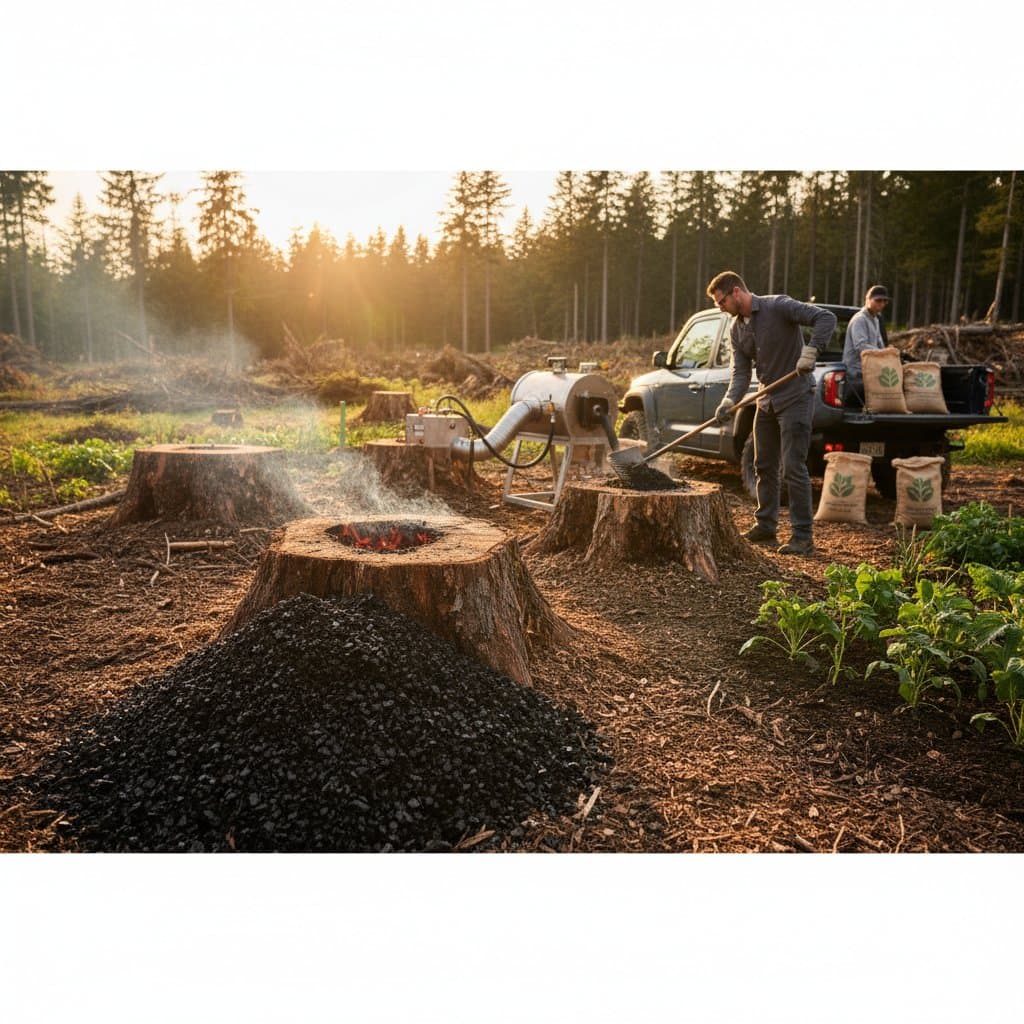
Convert Tree Stumps to Biochar: Unlock Up to $800 in Revenue
Tree stumps often represent an unexpected expense for homeowners and landscapers after removal. Rather than disposing of this wood waste at a cost, individuals can process it into biochar, a valuable soil amendment that commands strong market prices. This approach not only recoups removal expenses but also generates revenue, with a single large stump potentially yielding up to $800 worth of product. The following sections detail the process, from cost analysis to production techniques, enabling readers to evaluate this opportunity for their operations.
Understanding Costs in Stump Removal and Biochar Production
National Averages for Stump Removal
Across the United States, professional stump grinding services charge between $150 and $500 for most residential jobs, depending on the stump's size and location. Full extraction, which involves digging out roots, escalates costs to $300 to $1,200 or more. These figures reflect labor, equipment rental, and disposal fees, which vary by region and accessibility.
Revenue Potential from Biochar Conversion
Processing a stump into biochar shifts the equation toward profitability. A typical medium-sized stump provides 30 to 60 pounds of usable wood chips. Through pyrolysis, this material yields 15 to 30 pounds of biochar, which retails at $20 to $40 per pound in bulk or packaged forms. For larger stumps exceeding 24 inches in diameter, yields can reach 100 pounds or more, translating to $800 in potential sales after accounting for production costs.
Essential Cost Breakdown
Several factors influence the net profit from biochar production:
- Equipment Investments: Initial purchases include a stump grinder ($500 to $2,000 for entry-level models) and a pyrolysis kiln ($200 for DIY barrels to $5,000 for efficient units).
- Energy Requirements: Pyrolysis demands heat sources like propane burners or wood fires, costing $50 to $150 per batch depending on scale.
- Labor Inputs: Grinding and processing a stump requires 2 to 4 hours for a solo operator, or less with assistance; value this at local wage rates.
- Packaging and Distribution: Bags, labels, and transport add $1 to $3 per pound, but these enhance perceived value for sales.
- Market Variables: Demand in agricultural areas boosts prices, while urban settings may require online platforms for reaching buyers.
By subtracting production costs from sales revenue, most operations achieve 50 to 70 percent margins on biochar from stumps.
Biochar Varieties Derived from Stump Wood
Stump material varies by tree species, influencing the biochar's properties and market appeal. Selecting appropriate types ensures optimal soil benefits and customer satisfaction.
Biochar from Hardwood Stumps
Species such as oak, hickory, or maple produce biochar with exceptional density and carbon stability. This type excels in retaining water and nutrients over extended periods.
Advantages:
- Superior durability in soil applications, lasting years without degradation.
- Enhanced microbial activity, promoting healthier plant growth.
- Attracts premium buyers, including organic farms seeking certified products.
Challenges:
- Demands temperatures above 800 degrees Fahrenheit for complete carbonization.
- Longer processing times, often 4 to 6 hours per batch.
Biochar from Softwood Stumps
Pine, fir, or cedar stumps yield lighter biochar with greater porosity, ideal for improving drainage in heavy soils.
Advantages:
- Faster production cycles, completing in 2 to 3 hours at lower temperatures.
- Effective for amending clay or compacted soils, enhancing aeration.
Challenges:
- Reduced longevity, breaking down within 1 to 2 years.
- Marginally lower resale value, typically 10 to 20 percent below hardwood varieties due to less density.
Blended Biochar from Mixed Stumps
Combining hardwoods and softwoods creates a versatile product suited to diverse gardening needs.
Advantages:
- Uniform particle size and absorption qualities for broad applications.
- Flexibility in formulation to match specific soil tests or customer requests.
Challenges:
- Inconsistent carbon content requires batch testing for quality control.
- Additional steps for mixing and homogenization increase minor labor costs.
Choosing Between DIY Production and Professional Services
Homeowners or small-scale operators often start with DIY methods to test feasibility. A basic setup involves a 55-gallon metal drum modified as a kiln, costing under $100 in materials. Users must monitor temperatures between 600 and 1,000 degrees Fahrenheit to avoid incomplete charring or safety hazards like flare-ups. This method suits batches under 50 pounds and personal experimentation, though it limits scalability.
For larger volumes or consistent quality, hiring professionals or investing in commercial equipment proves worthwhile. Services specializing in biochar production handle permitting, waste management, and certification, charging $10 to $20 per pound processed. Such partnerships allow focus on sales while ensuring compliance with environmental regulations. Evaluate based on production goals: DIY for low-volume trials, professionals for business expansion.
Step-by-Step Guide to Biochar Production from Stumps
Transforming a stump into biochar follows a structured sequence to maximize yield and quality. Each stage requires attention to detail for safe, efficient results.
-
Prepare the Stump Material: After removal, use a chainsaw or grinder to reduce the stump and roots into uniform chips no larger than 2 inches. Remove soil, rocks, or contaminants to prevent impurities in the final product.
-
Dry the Chips Thoroughly: Spread the material on a tarp in a sunny, ventilated area for 3 to 7 days, or use a low-heat dryer if available. Aim for less than 15 percent moisture content to ensure even pyrolysis.
-
Set Up the Pyrolysis Kiln: Load dried chips into a metal retort or drum with limited oxygen access. Seal vents partially to control airflow and prevent full combustion.
-
Apply Controlled Heat: Ignite an external fire or use a burner to raise internal temperatures gradually to 700 degrees Fahrenheit. Maintain this for 2 to 4 hours, monitoring smoke color—white indicates complete carbonization.
-
Cool and Process the Biochar: Quench with water or allow natural cooling in an airtight container to preserve structure. Once cool, crush into granules using a hammer mill or manual tools, sifting to desired sizes (1/4 to 1/2 inch for most uses).
-
Package for Market: Fill breathable bags with 5 to 20 pounds each, adding labels detailing source, benefits, and usage instructions. Store in a cool, dry space to maintain efficacy.
Practical Strategies for Effective Biochar Operations
Success in biochar production hinges on refined techniques and targeted outreach. Implement these practices to optimize output and sales.
- Monitor moisture levels rigorously; excess water prolongs heating and reduces yields by up to 30 percent.
- Prioritize safety with protective gear, fire extinguishers, and operation in open areas away from structures.
- Conduct soil tests on finished biochar to verify pH (typically 7 to 9) and nutrient-holding capacity, building buyer trust.
- Develop storage protocols, such as sealed bins, to avoid moisture reabsorption and carbon loss.
- Identify buyers through local networks: approach community gardens for small orders, or list on platforms like Etsy for nationwide reach. Highlight sustainability to appeal to eco-focused consumers.
Common Questions About Stump-to-Biochar Conversion
What Yield Can Expect from a Single Stump?
A standard 18-inch diameter stump generates 15 to 25 pounds of biochar under optimal conditions. Yields increase with denser woods and efficient processing, potentially doubling for oversized specimens.
What Equipment Is Necessary for Biochar?
Beginners require minimal tools: a grinder, drying surface, and basic kiln. Scaling up involves automated kilns for precise temperature control and higher throughput.
How Does Biochar Benefit the Environment?
Production sequesters carbon long-term, mitigating emissions from wood decay. It also improves soil health, reducing fertilizer needs and runoff in agricultural settings.
Where Can Sell Locally Produced Biochar?
Target garden supply stores, hardware outlets, and farmers' markets. Emphasize local sourcing and custom blends to secure repeat business.
Are All Stump Types Suitable?
Most work effectively, though avoid treated or diseased wood to ensure product safety. Hardwoods offer premium quality, while softwoods provide quicker turnaround.
Scaling Your Biochar Venture for Sustained Income
Integrating stump-to-biochar conversion into landscaping or arborist services creates a recurring revenue stream. Start small to refine processes, then expand through partnerships with tree removal companies. This model not only diverts waste from landfills but also positions operations as leaders in sustainable practices, fostering long-term client loyalty and market growth.