
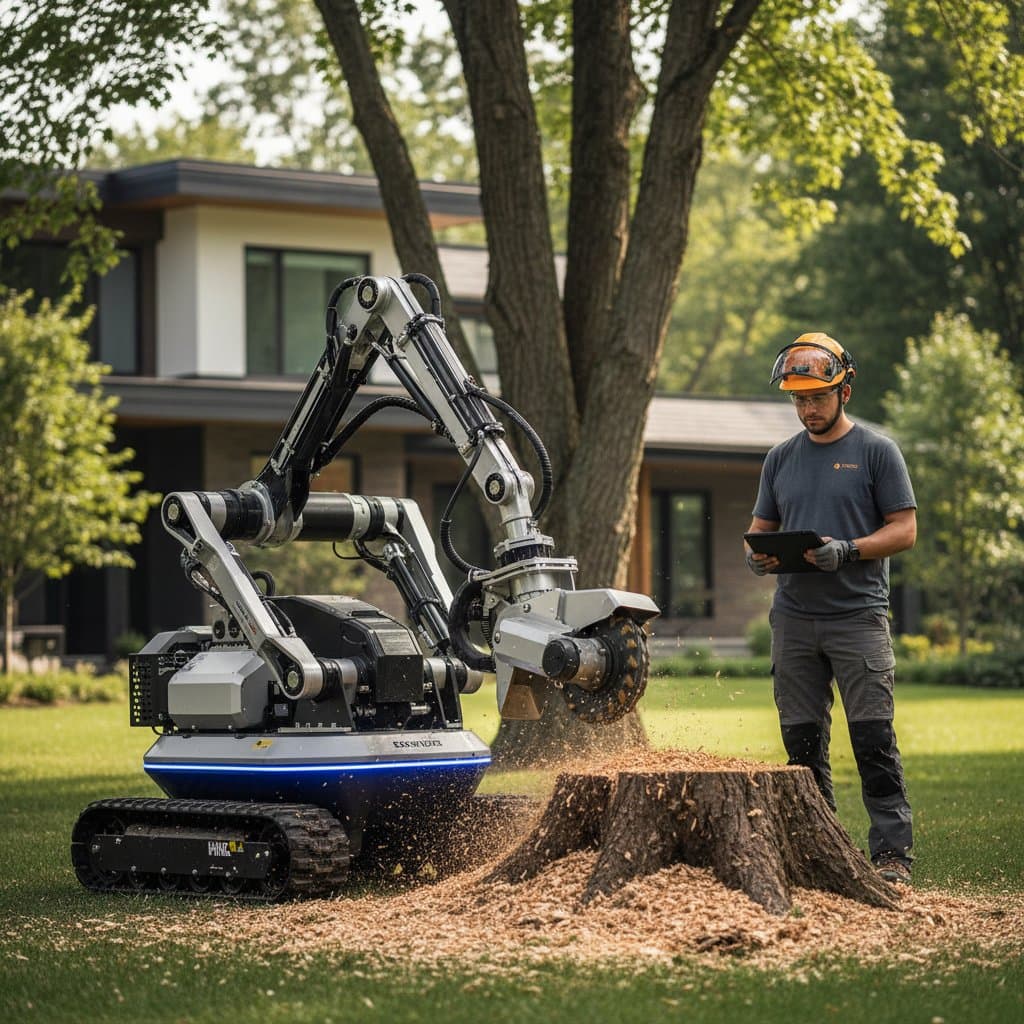
Stump Grinding Robots: Revolutionizing Removal with 3X Speed
Removing tree stumps has long presented challenges in tree care and land restoration projects. Traditional methods demand manual operation, frequent equipment adjustments, and heightened safety vigilance. Robotic stump grinders address these issues by offering unprecedented speed, accuracy, and reliability, often completing tasks three times faster than manual approaches. This efficiency reduces labor expenses and minimizes project timelines.
This article explores the mechanics of robotic stump removal, factors influencing costs, available system types, and guidance for homeowners and contractors on selecting the best approach.
Understanding Robotic Stump Grinding Costs
National Averages
Robotic stump grinding services generally align with or slightly exceed standard rates due to the integration of sophisticated technology. The national average falls between $150 and $500 per stump, depending on size and location. Shorter operation times frequently balance any initial premium, particularly in projects involving several stumps or expansive sites.
Costs Based on Project Scale
- Small stumps (less than 12 inches in diameter): These require only a few minutes of robotic operation, resulting in costs around $100 to $200, lower than manual equivalents owing to decreased hands-on time.
- Medium stumps (12 to 24 inches): Rates mirror traditional services at $200 to $400, yet the accelerated process preserves overall schedule efficiency.
- Large or multiple stumps: Here, automation excels, with per-stump costs dropping to $300 to $600 for batches, yielding substantial savings through streamlined workflows.
Influential Cost Elements
Several variables determine final pricing for robotic services.
- Automation degree and equipment specifications: Fully autonomous models command higher fees than semi-automated options.
- Site access and ground conditions: Uneven terrain or remote locations increase setup expenses.
- Stump quantity and dimensions: Larger volumes benefit from bulk efficiencies.
- Supervision requirements: Operator oversight adds to labor charges.
- Logistics for transport and deployment: Moving heavy robotic units incurs additional fees.
- Regional service demand: Urban areas with high adoption may adjust rates upward.
Exploring Robotic Stump Grinding Systems
Robotic systems vary in autonomy and design to suit different operational needs.
Fully Autonomous Models
These advanced units employ sensors, GPS mapping, and AI algorithms to operate without direct human input. They detect obstacles, adjust grinding paths, and maintain optimal depths automatically.
Advantages:
- Achieve three times the speed of manual grinding through uninterrupted operation.
- Demand little to no on-site supervision, freeing personnel for other tasks.
- Deliver uniform results with precise control over cut depths and patterns.
Disadvantages:
- Involve elevated purchase or rental prices, often starting at $50,000 for ownership.
- Remain scarce in rural regions, limiting immediate access.
Semi-Autonomous Systems
Operators control these via remote interfaces, while built-in automation handles positioning and depth adjustments. This hybrid approach balances control with efficiency.
Advantages:
- Simplify handling compared to fully manual equipment, reducing physical strain.
- Lower injury risks through distant operation capabilities.
- Offer cost savings over full autonomy, with rentals from $1,000 per day.
Disadvantages:
- Necessitate certified personnel for oversight and adjustments.
- Operate at a pace slightly below that of independent robots.
Attachments for Existing Machinery
Robotic grinding heads attach to skid steer loaders, enhancing standard equipment with automated features like auto-leveling and sensor-guided cuts.
Advantages:
- Provide versatility for users with compatible base machines, supporting diverse site tasks.
- Facilitate straightforward servicing using familiar parts networks.
- Enable quick integration without full system overhauls.
Disadvantages:
- Yield less accuracy than standalone robots due to base unit dependencies.
- Rely on the host machine's engine power and balance for performance.
Deciding Between DIY and Professional Services
Homeowners might consider robotic systems for personal projects, but access remains a barrier. Most units demand technical setup, including software calibration and hazard scans, beyond typical DIY skills. Moreover, personal use often voids warranties or insurance protections against property damage.
Professionals bring expertise in deploying these technologies across varied landscapes. They navigate utilities, manage root systems, and process multiple stumps efficiently in a single outing. For estates or business properties, their services can halve completion times while ensuring compliance with safety standards.
Step-by-Step Guide to Robotic Stump Removal
Follow these structured steps to execute a robotic grinding project effectively.
- Evaluate the location: Measure stump diameters, trace root extents, and scan for buried lines or structures using ground-penetrating tools.
- Select appropriate equipment: Match the system to site constraints, such as choosing compact models for tight spaces.
- Define operational zones: Place markers or virtual boundaries to direct the robot's path and prevent overreach.
- Perform initial setup: Calibrate sensors and input GPS coordinates to create a precise work map.
- Initiate the process: Activate grinding via the control panel, observing via live feeds for any anomalies.
- Post-operation cleanup: Remove wood chips, inspect the depth (typically 6-12 inches below grade), and prepare the area for soil backfill or new planting.
Best Practices for Effective Robotic Grinding
To maximize outcomes, adhere to these targeted recommendations.
- Choose equipment suited to local soil density and wood species hardness for optimal blade performance.
- Establish a 10-foot safety buffer around active zones to protect bystanders and structures.
- Monitor environmental moisture to control dust; apply water sprays if conditions turn dry.
- Conduct routine inspections of cutting teeth, motors, and electronics to sustain reliability.
- Record operational data, including times and yields, to refine future applications.
Common Questions About Robotic Stump Grinders
Are robotic stump grinders safe for residential yards?
Yes, these systems incorporate multiple safety features, including obstacle detection sensors and automatic shutdowns. They minimize vibration and noise compared to manual grinders, preserving nearby plants and hardscapes when operated by trained users.
How deep can robotic stump grinders go?
Most models achieve depths of 12 to 24 inches, adjustable via software settings. Depth capabilities depend on stump size and soil type, with larger units handling tougher roots more effectively.
Do robotic grinders damage nearby landscaping?
Designed with precision, they follow programmed paths to avoid unintended contact. Professionals use protective barriers and pre-scan for risks, ensuring minimal impact on gardens, fences, or irrigation lines.
Can I rent a robotic stump grinder?
Rental options exist through specialty equipment firms, typically for $500 to $2,000 per day. Availability varies by region; confirm operator training requirements before booking.
Are robotic stump grinders eco-friendly?
They promote sustainability by reducing fuel consumption through efficient operation and limiting soil disturbance. Electric models further decrease emissions, supporting greener land management practices.
Integrating Robotics into Your Tree Care Routine
Adopting robotic stump grinding elevates efficiency in both residential and commercial settings. Contractors gain competitive edges through faster turnarounds, while property owners enjoy quicker restorations. Evaluate your needs against available technologies to unlock these benefits and streamline future projects.