
- Supplementary Materials: Additions like compost or inoculants incur minor extra costs yet enhance efficacy.
This method undercuts grinding expenses, which span $150 to $300 per stump, and excavation, often surpassing $500 for extensive roots.
Biochar Varieties Suitable for Stump Decomposition
Biochar results from pyrolyzing wood or organic residues in oxygen-limited environments, yielding a carbon framework that nurtures microorganisms. Selection of the appropriate type directly impacts decomposition velocity.
Hardwood-Derived Biochar
This variant offers density and durability, excelling in nutrient and moisture retention.
Advantages:
- Sustains microbial communities over extended periods due to structural integrity.
- Efficiently captures nitrogen compounds.
- Suited for substantial or hardwood stumps.
Disadvantages:
- Activation proceeds more slowly owing to compactness.
- Pricing exceeds that of softwood alternatives.
Softwood-Derived Biochar
Lighter and more porous, this type facilitates rapid integration and initial microbial surge.
Advantages:
- Promotes swift activation for accelerated decay.
- Integrates seamlessly with soil or compost.
- Readily accessible at lower prices.
Disadvantages:
- Breaks down faster, potentially necessitating replenishment for sizable stumps.
Biochar from Agricultural Byproducts
Produced from materials like corn stover or coconut shells, it features exceptional porosity and inherent nutrients.
Advantages:
- Creates superior habitats for microbes.
- Aligns with sustainable practices.
- Frequently contains embedded minerals.
**Disadvantages:**n- Prone to compaction in saturated soils.
- Benefits from added nitrogen sources.
A combination of hardwood and softwood biochar often delivers optimal performance, balancing endurance with prompt initiation.
DIY Application Versus Professional Services
Implementing the DIY Method
Homeowners can effectively deploy biochar for stump breakdown. The procedure entails drilling into the stump, introducing an activated biochar blend, and sustaining moisture while covering the area. Primary difficulties involve achieving thorough wood infiltration and consistent hydration.
DIY Benefits:
- Minimized financial outlay.
- Complete oversight of components and schedule.
- Educational gains in soil biology and ecology.
Potential Hurdles:
- Demands ongoing vigilance and perseverance.
- Outcomes fluctuate with execution and climatic factors.
- Imprecise mixtures may prolong the process.
Engaging Professionals
For numerous stumps, expansive roots, or time constraints, experts streamline the operation. Arborists or sustainable landscapers possess tools for precise drilling and uniform distribution.
Professional Advantages:
- Thorough evaluation of stump and soil conditions.
- Expedient, consistent application.
- Incorporation of advanced inoculants or composts for superior results.
- Minimized chances of errors or imbalances.
DIY suits modest stumps, while professionals excel with complex scenarios, guaranteeing thorough disintegration.
Step-by-Step Guide to Biochar Application for Rapid Decomposition
Biochar augments natural rot by supplying carbon alongside nitrogen and water, cultivating environments for lignin- and cellulose-degrading fungi and bacteria.
1. Stump Preparation
Lower the stump to ground level using a saw. Strip away bark and debris to reveal raw wood, facilitating biochar ingress.
2. Creating Entry Points
Employ a 1-inch drill bit to bore holes atop the stump, spaced 2 to 3 inches apart. Extend each 8 to 10 inches deep, or to the stump base. For larger specimens, add angled side holes.
3. Biochar Activation
Raw biochar lacks vitality. Blend it with nitrogen providers, such as compost tea or diluted fertilizer, and allow 24 hours for nutrient and microbial infusion into its pores.
4. Introducing the Blend
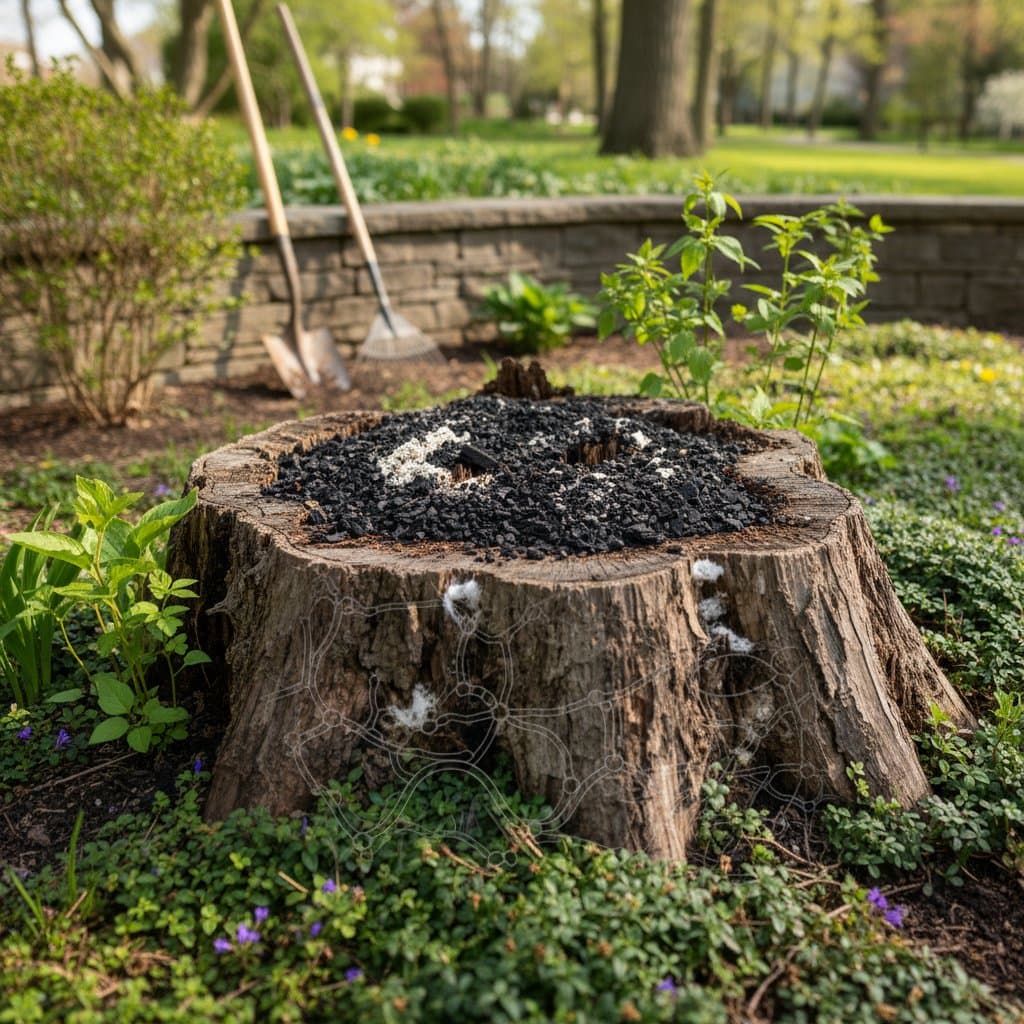
Pack holes with the prepared mixture. Disperse extra biochar at the stump base, incorporating it into the upper soil layer to establish a comprehensive microbial network.
5. Moisture Management and Protection
Regular watering sustains essential hydration, particularly in arid spells. Apply a tarp or mulch layer to preserve warmth and prevent evaporation.
6. Ongoing Assessment and Adjustment
Examine progress biweekly. Upon softening, replenish with fresh biochar or compost. Decomposition advances, enabling manual fragmentation, typically concluding eight months ahead of unaided decay.
Strategies for Optimal Biochar Stump Removal
- Carbon-Nitrogen Equilibrium: Excess carbon impedes progress; pair biochar invariably with nitrogen sources like manure.
- Controlled Hydration: Maintain dampness to nurture microbes, avoiding waterlogging that hinders aeration.
- Fungal Enhancement: Introduce mycorrhizal fungi or decayed leaves to amplify breakdown.
- Layered Reapplications: Add biochar periodically to sustain active populations.
- Natural Culmination: Remove coverings once softened, permitting air to finalize fiber dissolution.
Common Inquiries
In What Manner Does Biochar Hasten Stump Breakdown?
Its porous architecture shelters microbes and fungi. Paired with nutrients and water, these agents rapidly infest the stump, dismantling resilient fibers that endure for years otherwise.
Does Biochar Pose Environmental Risks?
Biochar supports ecological integrity. Pyrolysis sequesters carbon stably, averting emissions, and post-decomposition, it ameliorates soil quality.
Might Biochar Supplant Grinding?
It diminishes stump volume and rigidity swiftly, sans physical extraction. For those favoring non-invasive, chemical-free paths, it serves as a viable substitute.
What Duration Applies to Biochar-Assisted Decomposition?
Timelines differ, yet biochar typically trims eight months from natural rates. Wood species, hydration, and microbial vigor dictate speed.
Is Post-Decomposition Cleanup of Soil and Biochar Required?
No. The resultant biochar-amended soil enhances planting, retaining moisture and nutrients for landscaping.
Is Homemade Biochar Feasible?
Affirmative. Pyrolyze dry wood or residues in oxygen-restricted setups, cool, pulverize, and activate with compost prior to use. Proper execution yields effective results.
Implement Biochar for Sustainable Yard Renewal
Biochar transcends mere expediency; it harmonizes with ecological cycles to convert impediments into assets. This technique demands minimal investment while yielding fertile ground.
Commence with biochar to bypass machinery and toxins. For extensive projects, consult experienced arborists versed in regenerative practices. Reclaim space efficiently and foster enduring soil vitality.