
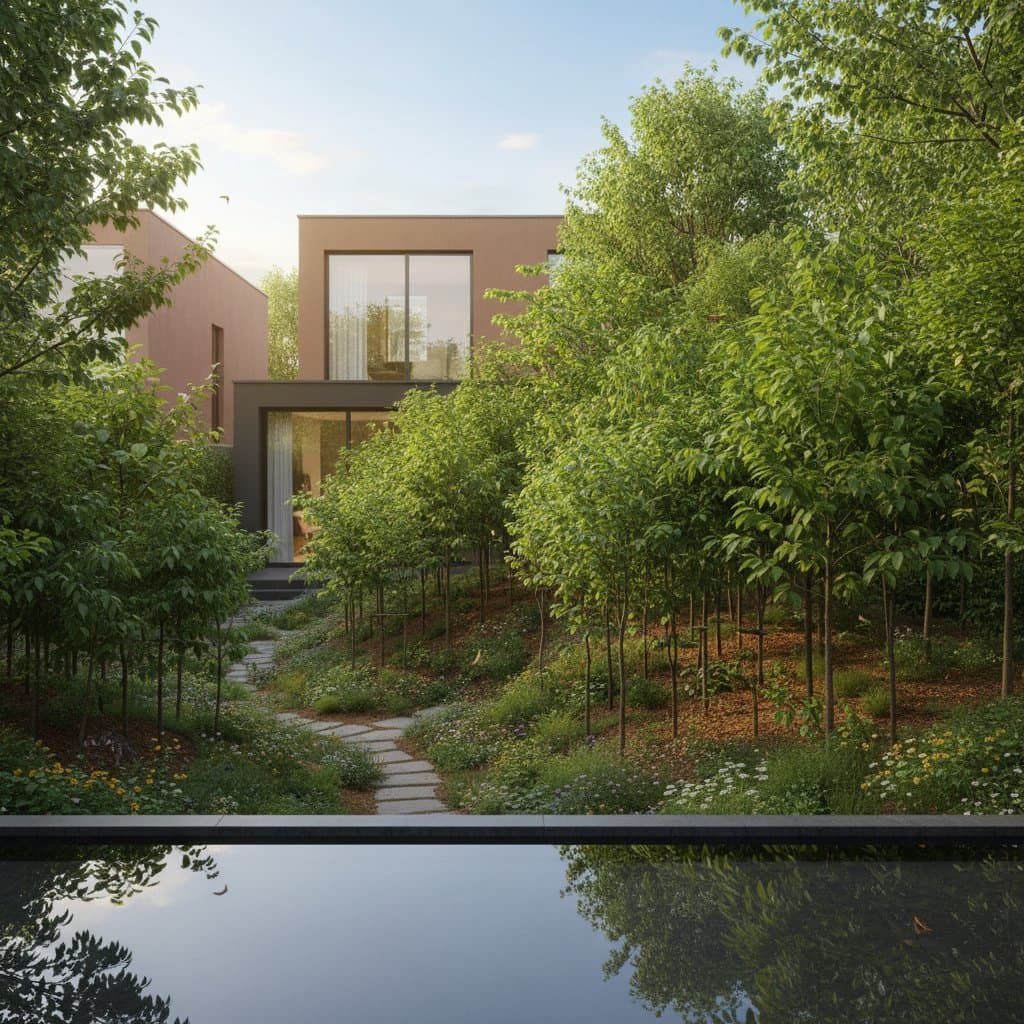
Why Micro-Forests Accommodate 300 Trees in Compact Yards
A dense forest appears unattainable in limited yard space, yet the Miyawaki method redefines this possibility. This technique employs dense planting and natural growth emulation to convert small areas into robust ecosystems. Homeowners achieve maximum greenery while cultivating accelerated, resilient landscapes that enhance local biodiversity.
Principles Behind Dense Micro-Forests
Micro-forests draw from natural forest regeneration processes, replicating wild growth dynamics. Rather than spacing a handful of mature trees widely, this approach positions numerous saplings in proximity, typically three to five per square meter. Such density sparks competition for resources, compelling plants to extend upward swiftly and develop sturdy structures.
This configuration yields a self-regulating miniature forest that establishes rapidly with reduced upkeep. The system enhances atmospheric purity, moderates ambient heat, and draws in pollinators, avian species, and advantageous insects, fostering a balanced habitat.
Mechanics of the Miyawaki Method
The Miyawaki method constitutes a scientifically validated reforestation strategy designed for ecosystem revival in urban or compromised environments. It emphasizes indigenous plant choices and compact arrangements to generate autonomous forests.
Essential Phases of the Miyawaki Process
-
Site Evaluation and Ground Preparation
Conduct thorough soil analysis to identify pH levels, nutrient deficiencies, and drainage patterns. Amend the earth with organic materials like compost, leaf mold, or well-rotted manure to foster an optimal foundation for root expansion. -
Selection of Indigenous Varieties
Identify plants from regional woodlands, incorporating tall canopy trees, mid-level understory shrubs, and low-lying ground covers. This assortment mirrors authentic forest stratification, promoting symbiotic interactions among species. -
Implementation of Close Spacing
Position saplings in groups of three to five within each square meter, varying heights to simulate natural layering. This arrangement accelerates vertical development while minimizing lateral spread. -
Application of Mulch and Initial Nurturing
Spread a generous layer of organic mulch, such as wood chips or straw, to conserve water and inhibit weed emergence. Provide consistent irrigation for the initial two to three years to secure establishment and vitality. -
Facilitation of Ecological Progression
As plants mature, permit natural processes to dominate. Decaying foliage replenishes soil fertility, and the ecosystem evolves with limited intervention, achieving sustainability.
Suitability of Micro-Forests for Limited Spaces
Conventional yard design favors expansive turf and decorative flora, often at the expense of ecological depth. Micro-forests invert this paradigm by prioritizing compactness and species variety. Close proximity allows hundreds of specimens to thrive in confined zones, forming a scaled-down habitat.
For example, a thirty-square-meter plot accommodates up to 300 trees and shrubs via the Miyawaki technique. Vertical utilization of space through tiered vegetation delivers forest-like ambiance and utility without expansive land requirements.
Advantages of Establishing a Compact Micro-Forest
- Accelerated Maturation: Plants develop up to ten times quicker compared to standard configurations.
- Enhanced Atmospheric Filtration: Abundant leaves capture contaminants and generate oxygen at elevated rates.
- Temperature Mitigation: Dense cover offers substantial shading and evaporative cooling.
- Elevation of Biological Diversity: Indigenous flora summons essential pollinators and fauna.
- Reduced Upkeep Demands: Established systems maintain equilibrium with occasional oversight.
Comparing DIY Implementation and Professional Assistance
Embarking on a micro-forest project independently suits those with gardening experience and available time. DIY efforts involve hands-on soil work, plant sourcing from local nurseries, and ongoing monitoring, which can prove rewarding yet labor-intensive. Beginners benefit from starting small, perhaps with a ten-square-meter test plot, to master techniques before scaling up.
Hiring professionals, such as landscape ecologists or certified arborists, ensures precision in species matching and site optimization. Experts handle permits, soil testing via laboratory analysis, and initial planting for optimal survival rates above 90 percent. This option proves ideal for complex urban sites or those seeking guaranteed outcomes, though it incurs higher initial costs.
Initiating Your Micro-Forest Project
-
Evaluate Available Area
Quantify dimensions, assess sunlight duration (aim for at least six hours daily), and evaluate water flow to avoid pooling. -
Procure Suitable Indigenous Plants
Consult regional extension services or botanical gardens for recommendations on canopy species like oaks, understory options such as dogwoods, and ground covers including ferns. -
Enhance Soil Composition
Incorporate two to four inches of compost, tilling it into the top six inches of soil, and test for balanced nutrients using home kits or professional labs. -
Design Planting Configuration
Sketch clusters by height categories, ensuring taller trees anchor the center and shorter plants fill edges for balanced aesthetics and function. -
Execute Dense Placement
Dig holes twice the root ball width, spacing plants twelve to eighteen inches apart, and firm soil gently to eliminate air pockets. -
Apply Protective Mulch and Irrigation
Layer three to four inches of mulch around bases, avoiding stem contact, and irrigate deeply weekly until roots anchor, transitioning to rainfall dependence.
Strategies for Achieving Micro-Forest Viability
Prioritize indigenous selections to guarantee resilience against local pests and weather fluctuations. Integrate multiple strata from towering trees to creeping vines for comprehensive coverage and habitat complexity. Steer clear of synthetic amendments that harm microbial communities in the soil.
Maintain steady hydration in establishment phases to promote extensive root networks reaching two feet deep. Encourage accumulation of natural debris to serve as ongoing nutrient sources and wildlife shelters.
Common Inquiries About Micro-Forests
What Quantity of Trees Fits a Compact Yard?
The Miyawaki method supports three to five trees per square meter. Compact areas thus host hundreds of saplings in organized, multi-tiered arrays.
Does a Micro-Forest Demand Extensive Upkeep?
Initial years require attention to watering and weeding. Maturity brings self-sufficiency, as the canopy controls undergrowth and preserves hydration.
Which Trees Suit This Approach?
Select natives adapted to your locale, such as maples in temperate zones or acacias in warmer climates. These choices bolster regional ecology and endure without extra support.
When Does a Micro-Forest Attain Maturity?
Visible structure emerges in three to five years, with full density by ten years, surpassing traditional growth timelines significantly.
Is Integration with Turf Areas Feasible?
Certainly, allocate sections for dense planting alongside open expanses for leisure or additional cultivation, blending utility and nature.
Realizing Ecological Harmony in Your Yard
Adopting dense planting through the Miyawaki method delivers enduring rewards, from purified air to vibrant wildlife presence. This investment in green space not only beautifies your property but also contributes to broader environmental health. Begin assessing your yard today to cultivate a legacy of sustainability.