
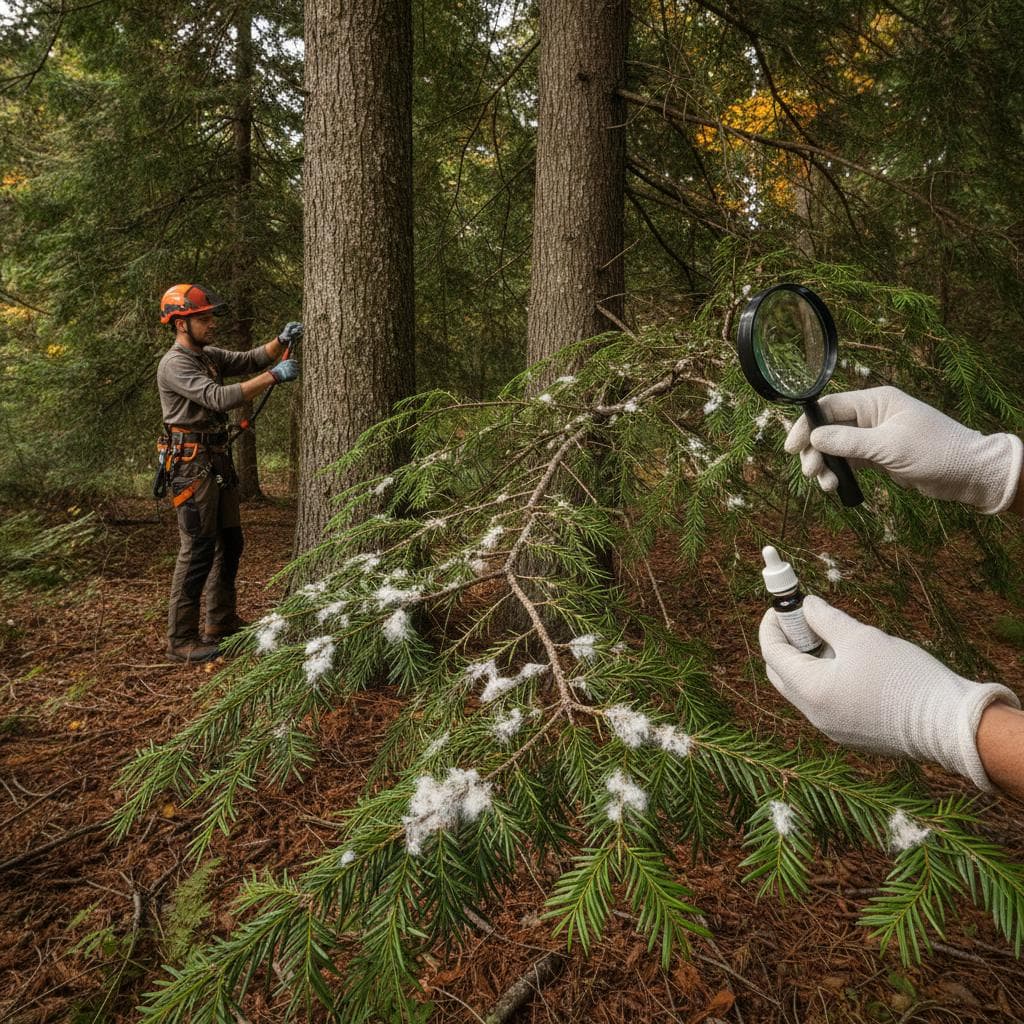
Hemlock Woolly Adelgid Hits Midwest: Protect Trees Now
Hemlock trees across the Midwest face a serious threat from a tiny but destructive insect known as the Hemlock Woolly Adelgid. Once confined to eastern regions, this invasive pest has spread into new territories and endangers forests, landscapes, and ornamental plantings. Homeowners and land managers must act quickly to protect trees before infestations cause irreversible damage.
This guide explains what the Hemlock Woolly Adelgid is, how to identify it, what treatment costs involve, and what options exist for professional and homeowner protection. With the right approach, valuable trees can be saved and landscape health restored.
Hemlock Woolly Adelgid Treatment Cost
National Average Cost
Treatment for a Hemlock tree infested with Woolly Adelgid typically ranges from fifty to two hundred dollars per tree. Cost depends on tree size, infestation severity, and chosen method. Chemical soil drenches and trunk injections remain the most common options, and annual follow-up applications are often required.
Cost by Project Size or Type
Individual landscape trees usually require fifty to one hundred dollars for a single systemic insecticide application. Large properties with multiple trees may incur costs from five hundred to several thousand dollars for full coverage. Forested areas often need aerial or ground spraying, which raises labor and material expenses.
Preventive treatments prove more affordable over time than removal and replacement of dead trees.
Key Cost Factors
- Tree size determines product volume and labor hours.
- Infestation severity often requires multiple treatments.
- Treatment method affects price, with soil drenches less costly than trunk injections.
- Access and location influence service time on remote or steep sites.
- Professional labor rates vary by local demand.
- Application frequency ranges from one season to several years of protection.
Types of Hemlock Woolly Adelgid Treatments
Soil Drench
A soil drench applies systemic insecticide around the tree base for root absorption. The chemical travels through the vascular system and kills adelgids during feeding.
This method works with minimal equipment and delivers long-lasting protection for both small and large trees. It acts more slowly than direct sprays and may fail on trees with poor root health. Careful measurement prevents runoff into surrounding soil.
Trunk Injection
Trunk injection places insecticide directly into vascular tissue through small ports drilled in the trunk. Results appear quickly and environmental exposure to surrounding soil stays limited.
The approach suits sensitive sites near water yet costs more than soil drenches. It requires professional equipment and repeated injections may cause minor trunk injury.
Foliar Spray
Foliar spray coats needles and branches to kill adelgids on contact. It serves ornamental trees and light infestations well.
Immediate pest reduction occurs, yet effectiveness remains short term. Application to tall trees proves difficult and requires protective gear plus suitable weather.
Biological Control
Predatory beetles and other natural enemies are released in selected areas to reduce adelgid numbers. Results vary, but this tactic supports long-term integrated management.
The method reduces chemical use and remains sustainable, though results develop slowly and require expert monitoring. Regional availability can be limited.
DIY versus Professional Care
Homeowners can manage small infestations or preventive soil drenches with over-the-counter insecticides labeled for Hemlock Woolly Adelgid. The process requires measuring trunk diameter, mixing the correct dose, and applying material evenly around the base.
Professional arborists supply specialized knowledge and equipment that ensure safe, effective results. They identify early symptoms, monitor long-term health, and apply trunk injections that demand precision. Licensed professionals may also use stronger systemic products that provide multi-year protection.
DIY treatment saves money initially, yet dosage or timing errors can reduce effectiveness or damage the tree. Professional service is recommended for large trees, valuable landscapes, or advanced infestations.
How to Protect Your Hemlocks
- Inspect trees several times each year for small white cotton-like masses on the underside of branches.
- Prune and destroy heavily infested limbs to lower pest populations while disinfecting tools between trees.
- Apply a properly labeled systemic insecticide as a soil drench or trunk injection when soil is moist but not saturated.
- Maintain consistent moisture and add mulch to regulate soil temperature without piling material against the trunk.
- Continue annual monitoring after treatment and repeat applications according to label directions.
- Avoid broad-spectrum insecticides that harm beneficial insects and support natural predator populations.
Tips for Long-Term Success
Consistency prevents rapid rebound of adelgid populations. Avoid excess nitrogen fertilization that produces tender growth attractive to pests. Proper tree spacing improves airflow and reduces stress. Keep records of treatment dates, products, and symptom changes. Local forestry or extension offices can supply region-specific advice at no charge.
Frequently Asked Questions
What does Hemlock Woolly Adelgid look like?
The adelgid is a tiny soft-bodied insect that produces white wool-like sacs at needle bases. These appear as clusters resembling small cotton balls along the underside of branches.
How fast can Hemlock Woolly Adelgid kill a tree?
Severe infestations can weaken and kill a hemlock within a few growing seasons. Untreated trees eventually decline through needle loss and reduced vigor.
Can infested trees be saved?
Early detection allows most trees to recover with proper systemic treatment. Moderately infested trees often rebound once feeding stops and new growth appears.
Is Hemlock Woolly Adelgid harmful to people or pets?
The insect itself poses no direct risk to humans or animals. Pesticide misuse creates the primary hazard, so label directions must be followed exactly.
Do I need to treat every hemlock on my property?
All hemlocks near an infestation should receive treatment or close monitoring. The pest spreads readily and untreated trees can reinfest treated neighbors.
Are there natural remedies that work?
Homemade or organic sprays may reduce some adelgids on contact yet rarely control large populations. Integrated management that combines cultural, chemical, and biological methods delivers the most reliable results.
Next Steps for Hemlock Protection
Early detection combined with consistent monitoring and timely treatment allows most hemlocks to survive and thrive for decades. Healthy trees continue to supply shade, habitat, and beauty to landscapes and ecosystems. Contact a certified arborist familiar with local conditions at the first sign of infestation to maintain strong, vibrant hemlocks.