
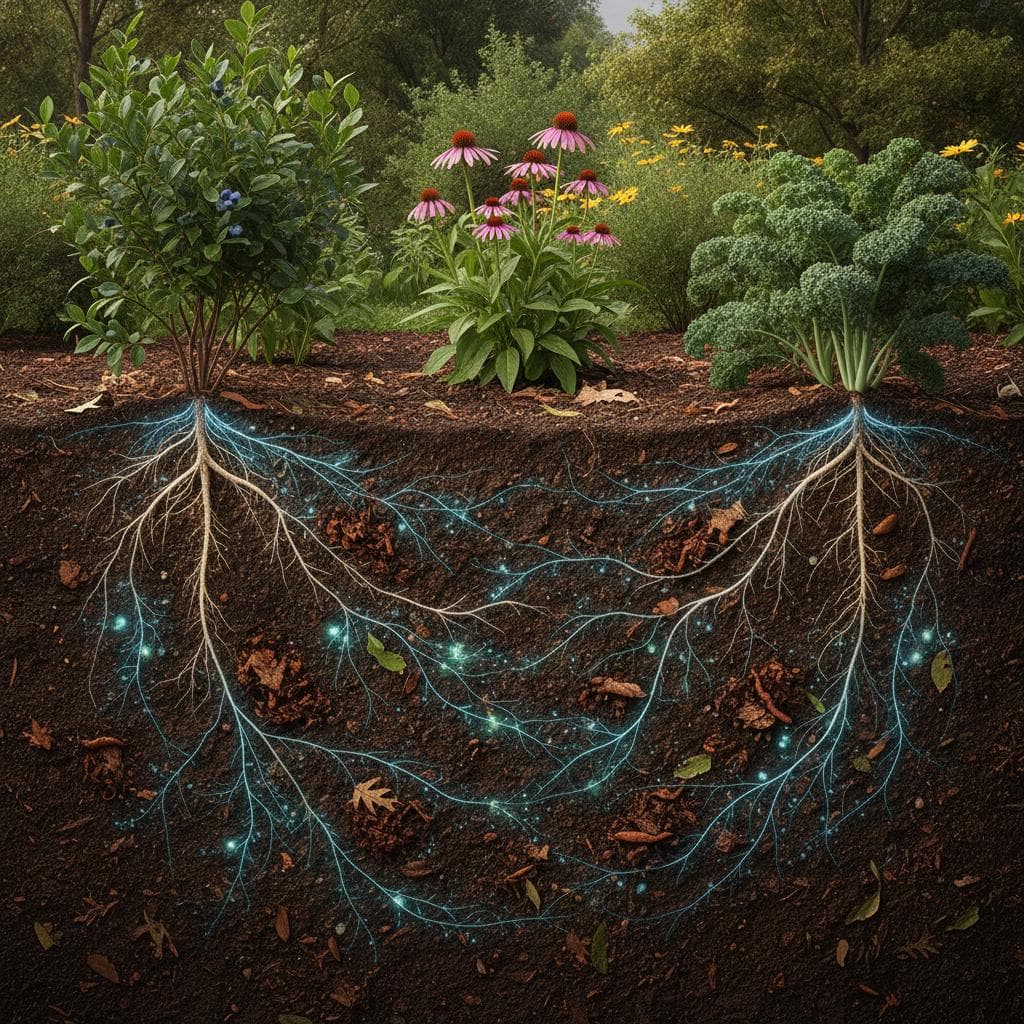
Mycelial Networks: Foundations for Stronger Root Systems
Healthy soil supports visible growth above ground through invisible fungal threads below. Mycelial networks link plant roots and enable exchanges of nutrients, water, and signals that improve overall plant performance. Gardeners and landscapers who understand these systems can reduce reliance on external inputs while building durable landscapes.
This overview covers the functions of mycelial networks, their effects on soil conditions, distinctions among fungal types, and practical steps to support them in home settings.
Functions of Mycelial Networks
Mycelium consists of fine hyphal threads that extend through soil and connect multiple plants. These threads transport resources between roots and relay chemical information about environmental pressures. The resulting cooperation strengthens community-level resilience in ways isolated plants cannot achieve alone.
Landscapes that host active networks establish new plantings more quickly and maintain function during dry periods.
Effects on Soil Conditions
Nutrient Processing
Fungal threads decompose organic residues and release elements in forms roots can absorb. This process maintains nutrient availability without repeated applications of synthetic products.
Moisture Management
The physical structureincreases the soil capacity to retain water. Roots therefore access stored moisture for longer intervals between irrigation events.
Suppression of Soil Pathogens
Established fungal populations occupy space and resources that disease organisms would otherwise exploit. This competitive presence lowers the incidence of root decay and related disorders.
Extension of Root Reach
Mycorrhizal fungi grow into fine soil pores beyond the physical limits of roots. Plants supplied through these partnerships obtain additional phosphorus and trace elements while the fungal filaments improve soil aggregation.
Categories of Mycorrhizal Fungi
Ectomycorrhizal Fungi
These organisms form a sheath around root surfaces and occur mainly with woody species such as pines, oaks, and birches.
- Strong performance in tree plantings and woodland-style designs
- Increased tolerance to certain soil diseases
- Limited compatibility with herbaceous or turf species
Endomycorrhizal Fungi
These fungi enter root cells and serve most vegetable, flower, and grass species.
- Broad association with common garden plants
- Improved uptake of phosphorus and micronutrients
- Slower establishment in compacted or chemically treated soils
Soil Care Practices That Support Networks
- Limit tillage and deep cultivation that severs existing hyphal connections.
- Apply finished compost to supply organic substrates for fungal growth.
- Maintain continuous surface cover with mulch to moderate temperature and moisture.
- Select planting mixes that include species known to host mycorrhizal partners.
- Reduce or eliminate fungicide applications that target beneficial organisms.
Professional Assessment Options
Small garden beds respond well to consistent home practices. Larger sites or areas with persistent establishment problems benefit from laboratory soil analysis and targeted inoculant application performed by trained practitioners. Early partnership formation during new installations produces longer-term stability.
Long-Term Maintenance Steps
- Rotate crop families to sustain diverse microbial communities.
- Water thoroughly at wider intervals to promote deeper root and fungal development.
- Monitor soil pH and organic matter through periodic testing.
- Combine plants with differing root depths to expand network coverage.
Purchasing and Applying Inoculants
Garden suppliers offer mycorrhizal products in powder or granule form. Application at planting time places the fungi in direct contact with root zones. Follow label rates and avoid combining these materials with high-phosphorus fertilizers that can inhibit colonization.
Timeline for Network Development
Initial thread growth appears within several weeks when soil temperature, moisture, and organic matter are favorable. Mature, interconnected systems require multiple seasons of consistent management.
Plant Species and Fungal Dependence
The majority of garden plants form associations with mycorrhizal fungi. Members of the brassica family often grow without these partners yet still profit from improved soil structureplants.
Establishing Durable Soil Communities
Consistent attention to organic matter, minimal disturbance, and plant diversity produces soil that sustains vigorous growth with fewer external resources. Over successive seasons the underground network becomes a stable foundation for the entire landscape.