
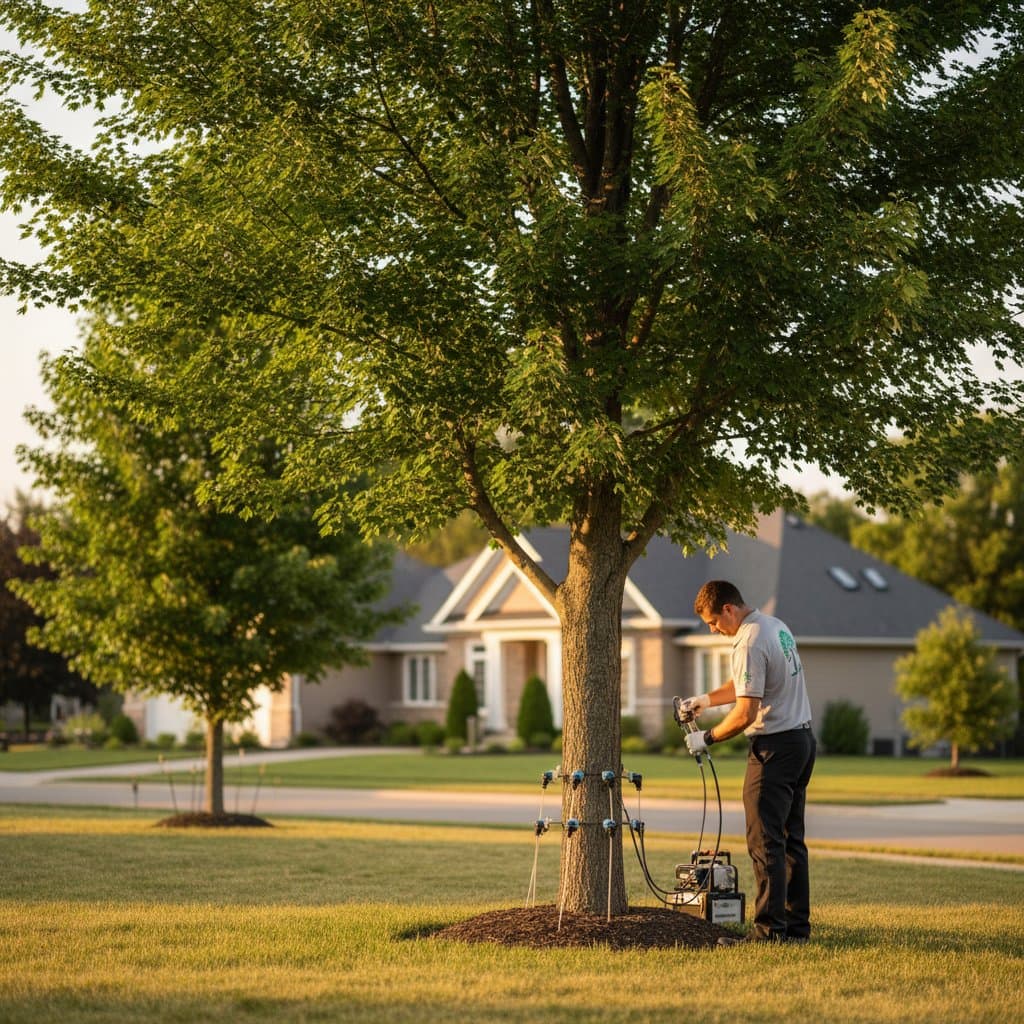
Why Homeowners Choose Ash Injections Over Tree Removal
The arrival of emerald ash borer in a community often triggers widespread concern among property owners. Ash trees begin to decline, prompting questions about whether removal represents the sole remedy. Increasing numbers of homeowners select ash injections as a strategic, enduring strategy. This precise intervention shields trees from pests, retains essential shade and elevates property worth, while circumventing the substantial expenses and disturbances associated with removal. Grasping the rationale behind this preference empowers owners to decide with assurance on preserving their landscape.
Ash Injection Costs
National Averages
Expenses for ash injections fluctuate based on factors such as tree dimensions, variety, and local labor expenses. Typically, treating a mature ash tree proves more economical than the combined costs of removal and replanting. For numerous properties, injections constitute only a portion of the total outlay for eradication and substitution. Such affordability positions treatment as a compelling option for managing emerald ash borer infestations.
Variations by Tree Size and Method
Treatments for smaller ash trees demand reduced quantities of material and effort, resulting in lower per-tree charges. Mature specimens necessitate more comprehensive applications, yet the comparative benefits versus removal amplify significantly. Routine trunk injections to counter emerald ash borer generally occur every one to two years, contingent on the tree's vitality and regional pest density. Over multiple applications, this approach frequently undercuts the financial burden of complete extraction and renewal.
Influential Cost Elements
- Tree dimensions: Greater size demands increased volumes of solution and workforce.
- Formulation variety: Diverse compositions differ in potency and longevity of defense.
- Workforce charges: Licensed arborists bill according to their skills and tooling requirements.
- Tree vitality: Robust specimens achieve superior outcomes and demand infrequent interventions.
- Site accessibility: Challenging locations or landscapes elevate effort and total expenditure.
Categories of Ash Injection Therapies
Emamectin Benzoate Applications
Professionals frequently employ emamectin benzoate as the primary defense against emerald ash borer. This compound enters the trunk and circulates via the tree's conductive tissues, eliminating larvae that consume layers under the bark.
Advantages:
- Demonstrates superior efficacy in suppressing emerald ash borer.
- Delivers extended safeguarding, typically spanning two years.
- Poses minimal risk to adjacent vegetation and ground when administered precisely.
Disadvantages:
- Necessitates execution by qualified specialists.
- Yields diminished results on heavily compromised or weakened trees.
Systemic Insecticide Deliveries
Alternative systemic insecticides distribute through the tree's internal pathways to discourage insect consumption. Arborists apply these when emamectin benzoate proves unavailable or when addressing assorted threats.
Advantages:
- Accommodates treatment for a range of pests.
- Integrates seamlessly with broader pest control methodologies.
Disadvantages:
- Offers briefer intervals of coverage.
- Relies heavily on accurate measurement and scheduling for optimal impact.
Nutritional Enhancement Injections
Certain specialists provide injections rich in nutrients to fortify ash trees alongside or following pesticide applications. These formulations incorporate essential fertilizers, vitality enhancers, or root-supporting elements to foster rehabilitation.
Advantages:
- Bolsters overall resilience and tolerance to environmental pressures.
- Enhances the efficacy of pesticide regimens for sustained benefits.
Disadvantages:
- Fails to eradicate emerald ash borer directly.
- Elevates expenses when paired with primary insecticidal measures.
Professional Service Versus Self-Application
Some property owners explore self-administered alternatives, yet trunk injection demands specialized knowledge. Incorrect selection of substances or quantities risks tree injury or ineffective pest control. Surface applications like soil soaks or foliar sprays might offer limited shielding for modest trees, but they seldom match the precision of expert injections.
Engaging a certified arborist guarantees thorough evaluation, exact dosing, and secure delivery. Experts utilize advanced tools to introduce treatments into the vascular network with minimal harm. They also align applications with the insect's developmental stages for maximum effect. This professional commitment typically yields prolonged tree longevity and diminished ongoing expenses.
For significant or expansive ash trees, expert involvement stands as the superior path. It instills confidence, delivers reliable outcomes, and leverages proven proficiency.
Steps for Administering Ash Tree Injections
1. Evaluate Tree Condition
Start with a detailed inspection to verify suitability for intervention. Identify indicators like sparse foliage, fractured bark, or distinctive D-shaped emergence points. An arborist performs a comprehensive assessment to ascertain salvage potential.
2. Select Appropriate Formulation
Choose a product certified for emerald ash borer mitigation. Review the label for active components and expected coverage period. Specialists calculate precise strength and volume according to the tree's measurements.
3. Prepare Injection Points
Drill modest apertures encircling the trunk base at uniform spacing. These accommodate the insertion devices. Aperture quantity correlates with trunk girth.
4. Install and Pressurize Delivery
Affix ports into the prepared sites, then introduce the treatment under regulated force. The mixture permeates the conductive channels, ensuring uniform dispersal.
5. Observe and Schedule Follow-Ups
Post-application, track indicators of improvement, including fresh shoots and denser leaf cover. Product specifications dictate subsequent doses every one to two years to sustain defense.
Strategies for Effective Ash Tree Management
- Initiate promptly: Apply treatments prior to severe pest buildup to maximize recovery chances.
- Engage qualified experts: Their knowledge secures ideal dosing and synchronization.
- Support overall wellness: Provide consistent irrigation and organic mulching to alleviate strain.
- Minimize trunk injuries: Avoid cuts that disrupt internal circulation.
- Adhere to schedules: Consistent reapplications thwart pest resurgence.
Common Inquiries
How Do Ash Injections Counter Emerald Ash Borer?
Injections transport insecticide into the tree's circulatory framework, targeting and destroying larvae beneath the bark. This interruption halts the insect's reproductive process and limits additional harm.
Can Injections Rescue an Infested Ash Tree?
Yes, in numerous instances. Trees retaining at least fifty percent viable canopy often halt progression and regain strength gradually. Extensively deteriorated specimens respond poorly and might necessitate extraction.
Do Ash Injections Endanger Pets, Animals, or Neighboring Flora?
Professional administration confines the insecticide within the tree's systems, avoiding soil pollution or threats to local fauna and companions.
What Is the Duration of Ash Injection Protection?
Standard formulations shield for one to two years. Longevity varies with the compound, specimen condition, and site factors.
What Occurs If Treatments Are Missed?
Omission permits pest resurgence. As efficacy fades, fresh infestations resume, inflicting progressive deterioration.
When Does Removal Surpass Treatment?
For trees exceeding fifty percent mortality or posing stability risks, extraction ensures safety. Experts assess viability to guide decisions.
Sustaining Ash Trees for Lasting Benefits
Ash injections present a scientifically validated substitute for removal, upholding the aesthetic and environmental contributions of established trees. They sustain cooling shade near residences and eliminate the burdens of substitution projects.
Prior to opting for removal, seek an arborist's appraisal of health and viable therapies. Through diligent upkeep and regular interventions, ash trees endure and flourish across seasons.